


Mornings usually win for a smooth ride, and late afternoon usually wins for dramatic light. That’s the trade-off at the heart of morning vs afternoon helicopter tours, and neither answer is wrong. Terrain and season can shift the odds, but if you’re choosing blind, book morning for comfort and golden hour for the photo you’ll actually print. Either way, checking a verified operator’s schedule on Helicopterstour before you commit beats guessing.
TL;DR:
- Morning flights are generally smoother due to stable atmospheric conditions, making them ideal for a comfortable helicopter ride.
- The best lighting for photography occurs during afternoon and sunset hours, which can provide richer colors and long shadows.
- Afternoon turbulence peaks between 1 PM and 5 PM, so booking before 10 AM or near sunset reduces the risk of rougher flights.
- Terrain and season significantly impact timing advice, with desert areas in summer and mountain routes often favoring morning flights.
- Booking early in your trip and choosing the time based on your priorities (comfort or photos) minimizes weather-related rescheduling risks.
Table of Contents
- Morning vs Afternoon Helicopter Flights: A Quick Trade-Off Guide
- Why Morning Helicopter Flights Are Usually Smoother
- Why Afternoon and Golden-Hour Flights Look Better in Photos
- How Terrain and Season Change the Morning vs Afternoon Rule
- Your Pre-Flight Checklist for Choosing a Time and Prepping Gear
- Booking Strategy: Backup Days and Operator Weather Policies
- How Helicopterstour.com Helps You Pick the Right Time
- A Simple Rule of Thumb for Picking Your Time
- Book the Time Slot That Matches Your Priorities
- Sources
- FAQ
Morning vs Afternoon Helicopter Flights: A Quick Trade-Off Guide
Before you dig into the aviation weather explanation, here’s the shorthand version you can use to book with confidence right now.
- Ride smoothness: Morning wins, consistently, across most destinations.
- Photo quality: Afternoon and sunset win for color, contrast, and long shadows.
- Temperature and comfort: Mornings run cooler, which matters in desert destinations; afternoons can mean a warmer cabin and glare until the sun drops.
- Cancellation and rescheduling risk: Afternoons carry a slightly higher weather-hold risk in summer and mountain terrain.
Midday tours split the difference. They’re rarely the smoothest or the most photogenic, but they’re often the easiest slot to book on short notice. Sunset flights need to be reserved as their own decision, not treated as “late afternoon plus a few minutes”. If you want backup days in case weather bumps your reservation, book your flight early in your trip, not on your last full day.
Why Morning Helicopter Flights Are Usually Smoother
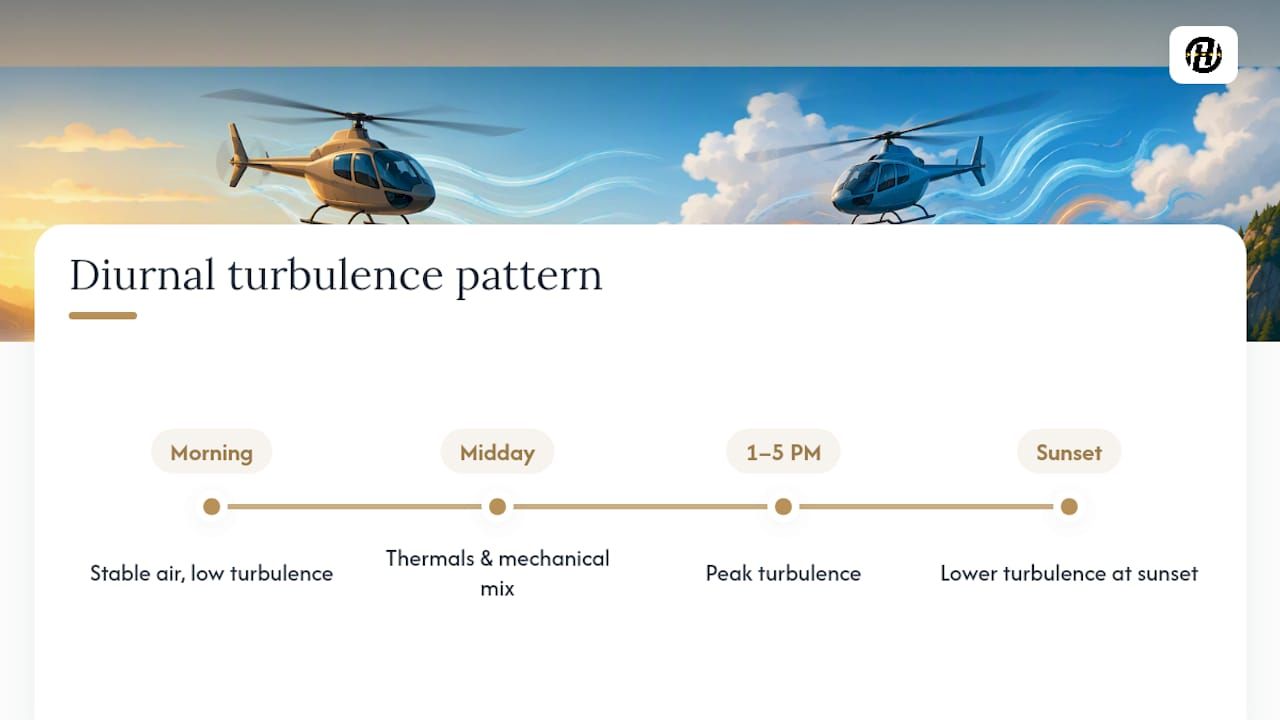
The air itself changes shape over the course of a day, and that’s the real reason morning helicopter advantages exist. Overnight, the ground cools and the atmosphere near the surface settles into a stable, layered state. There’s little vertical mixing, so a helicopter cruising at low altitude glides through air that hasn’t yet been stirred up.
Once the sun climbs, surface heating creates thermals: pockets of warm air that rise unevenly and jostle anything flying through them. Terrain adds a second layer of disturbance called mechanical turbulence, caused by wind dragging over ridges, canyons, and buildings. Both effects intensify as the ground heats up, which is why NOAA’s aviation weather briefings describe a clear diurnal pattern: turbulence builds through the day and typically peaks in the afternoon.
Statistic callout: Pilot-focused turbulence guidance from NOAA and the San Antonio Weather Service identifies roughly 1 PM to 5 PM as the window where low-level rides are commonly roughest, and recommends flying before 10 AM or within an hour or two of sunset to cut turbulence exposure.
For passengers, that translates directly into comfort. If you or anyone in your group gets queasy on boats or turbulent flights, an early morning slot meaningfully lowers your odds of a bumpy afternoon helicopter tour schedule turning your sightseeing into an endurance test.
Why Afternoon and Golden-Hour Flights Look Better in Photos
Smooth air isn’t the only thing that matters. Once you’re chasing the shot rather than just the view, the afternoon helicopter benefits become obvious. Low-angle sun during golden hour throws long shadows across canyons, coastlines, and skylines, deepening contrast in a way midday’s flat overhead light never manages. Colors saturate. Red rock destinations glow instead of looking washed out, and water surfaces pick up warm reflections that a noon flight simply can’t produce.
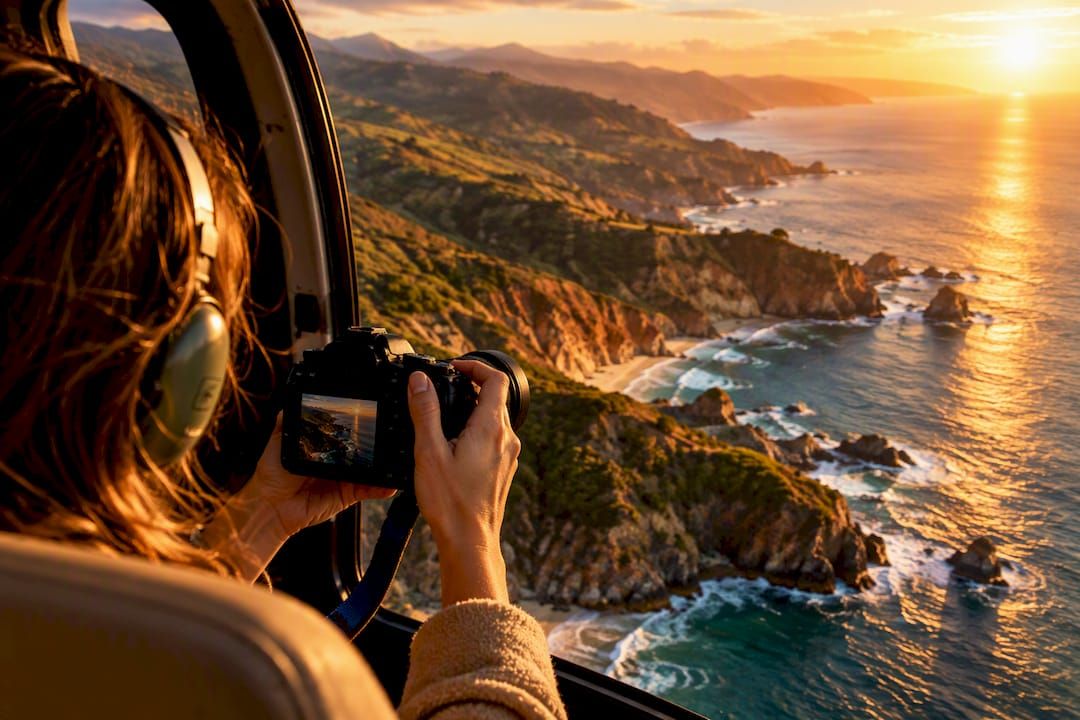
Slope orientation matters here more than most people realize. East-facing cliffs and canyon walls catch dramatic light early, while west-facing ridges and rock faces light up late in the day as the sun drops toward the horizon. Operators in scenic canyon country lean on this constantly when timing their most photogenic routes.
A few practical notes for anyone prioritizing images over comfort:
- Confirm which direction your route’s key landmarks face before choosing a departure time.
- Expect a slightly bumpier ride in exchange for the light, particularly in summer.
- Ask whether the operator’s sunset flight is a true golden-hour departure or just “later in the afternoon.”
- Bring a camera strap and a lens hood. Direct low sun through an open window creates flare fast.
Operators covering Kauai and Sedona both describe the same pattern in their own destination write-ups: mornings are calmer and clearer, while sunset flights trade some stability for color and drama, which is exactly the swap photographers are usually happy to make.
How Terrain and Season Change the Morning vs Afternoon Rule
The general rule bends depending on where and when you’re flying, and ignoring that is the most common mistake first-time bookers make.
- Desert and western destinations in summer: Afternoon thermals build fast and strong once ground temperatures spike, making the morning advantage even more pronounced than in milder climates.
- Coastal routes: Sea breezes often kick in by midday, which can smooth things out again in late afternoon after the roughest midday hours pass.
- Mountain terrain: Mechanical and wave turbulence off ridgelines can make afternoons rough well into evening, especially on windy days.
- Signals worth checking: rising cumulus cloud buildup, gusty surface winds, and a high forecasted mixing height all point toward a bumpier afternoon.
There are exceptions where midday or early afternoon actually works better, particularly along coasts where a steady sea breeze arrives on schedule and settles the air before a calmer late-afternoon window opens up. The rule of thumb still holds most of the time. It’s just not universal.
Your Pre-Flight Checklist for Choosing a Time and Prepping Gear
Turning all of this into a decision is simpler than it sounds. Walk through it in order:
- Rate your motion sensitivity. If you’re prone to queasiness, default to the earliest slot the operator offers.
- Decide what matters more: comfort or the shot. Photographers chasing golden hour should accept the turbulence trade-off going in, not discover it mid-flight.
- Check your schedule flexibility. A single fixed day means picking the safer morning slot; a multi-day trip gives you room to gamble on sunset.
- Choose your seat with intent. Window seats on the side facing your route’s main landmarks matter more than front versus back in most aircraft.
- Prep your camera. Lower your shutter speed floor for golden hour, secure straps against vibration, and dress for wind chill at altitude even on a warm day.
Pro Tip: Call or message the operator before booking and ask what “typical conditions” look like on their specific route at your chosen time. Local guides often know a canyon’s afternoon wind pattern better than any general forecast does.
Sun protection matters more than people expect, since cabin glass filters little of the sun’s intensity at altitude.
Booking Strategy: Backup Days and Operator Weather Policies
Book early in your trip, not on your last available day. That single habit does more to protect your experience than any amount of forecast-checking, because it leaves room to rebook if weather forces a hold.
- Ask directly about the operator’s cancellation and rebooking window before you pay.
- If you’re motion sensitive, request the earliest morning departure the schedule allows.
- If you’re booking for photography, reserve a late-afternoon or sunset slot but ask about an earlier backup in case of a weather call.
- Confirm the operator is FAA-certified and, where available, check how often they’ve had to reschedule flights on your chosen route.
Urban tours, including many New York City departures, often run multiple slots throughout the day, giving you more room to shift your booking if the forecast changes.
How Helicopterstour.com Helps You Pick the Right Time
Choosing a departure time is only half the problem. The other half is trusting the operator running it. Helicopterstour independently verifies that listed operators are FAA-certified, and cross-references thousands of traveler reviews so you’re not relying on a single glowing testimonial or a single angry one.
Tour listings are tagged with details that matter for this exact decision: which departures suit photographers chasing golden-hour light, which routes tend to run calmer in the morning, and what past travelers said about ride comfort at different times of day. That combination of operator verification and time-specific detail is what separates a quick web search from an actual best-time-of-day guide built for your specific route and season.
A Simple Rule of Thumb for Picking Your Time
My working rule is uncomplicated: book morning when you want the highest odds of a calm, predictable ride, and reserve late afternoon only when you’re specifically chasing one dramatic shot and you’ve accepted the turbulence premium that comes with it. Most travelers overthink this decision when the honest answer is a straightforward trade-off between two good options, not a search for a hidden “best” time that works for everyone.
The smarter version of this strategy is booking a morning flight early in your trip, then watching the forecast for a stable, low-wind evening later in your stay to add a sunset flight as a second booking rather than your only shot. You get the reliable experience first and the photograph second, instead of betting your entire trip on one afternoon slot.
— Justin
Book the Time Slot That Matches Your Priorities
This resource solves the problem of figuring out which operator, on which route, at which time of day, actually delivers what you want. Instead of piecing together forecast data and scattered operator reviews yourself, you get FAA-certified operator verification and aggregated traveler ratings in one place, organized by destination.

Search Helicopterstour by destination and departure time, read verified reviews before you commit, and check each operator’s weather and rebooking policy on the listing itself. If you want the full breakdown on timing before you book, the morning, midday, or sunset guide covers route-specific detail this article didn’t have room for. Start browsing tours now and lock in the slot that fits your priorities before your preferred dates fill up.
Sources
Turbulence and timing claims draw on NOAA’s aviation weather turbulence briefing and pilot-focused turbulence mitigation guidance, both used for the morning-smoothness explanation. Destination-specific photography and comfort tradeoffs come from operator write-ups on Kauai and Sedona flight timing.
FAQ
Is Morning or Afternoon Better for a Helicopter Tour?
Morning is generally better for a smoother ride because thermal and mechanical turbulence haven’t built up yet. Afternoon and sunset are better for photography, since low-angle light creates deeper shadows and richer color, according to NOAA aviation weather guidance.
What Time of Day Has the Roughest Helicopter Rides?
Roughly 1 PM to 5 PM is commonly the roughest window for low-level flights, based on pilot turbulence guidance. Booking before 10 AM or near sunset generally reduces your odds of hitting that window.
Does the Best Time Change by Destination?
Yes. Desert regions see stronger afternoon thermals in summer, mountain routes deal with mechanical turbulence off ridgelines, and coastal routes can settle down again once sea breezes kick in by midday. Checking local conditions for your specific route matters more than following a single blanket rule.
How Do I Find a Verified Operator for My Preferred Time?
Helicopterstour.com independently verifies FAA-certified operators and aggregates traveler reviews so you can compare morning and afternoon departures on the same route before booking. You can search by destination and departure time directly on Helicopterstour.
Should Photographers Always Book Sunset Flights?
Not always. Sunset delivers the most dramatic light, but it also carries a slightly higher chance of a weather hold in some regions, so photographers with only one day to fly should weigh that risk against the shot they want.
Recommended
- Best Time of Year to Take a Helicopter Tour, Weather and Visibility
- What to Expect on a Helicopter Tour: Before, During, and After
- Are Helicopter Tours Worth It? 5 Expert Insights on Costs and Experiences