
Pick a drone when you need nimble, low altitude, budget-friendly shots you can repeat until they’re right. Pick a helicopter when the brief calls for long-range coverage, heavier camera gear, or a location where drones simply aren’t allowed. Federal Aviation Administration rules and National Park Service restrictions often make that decision for you before image quality even enters the conversation, and Helicopterstour exists precisely for the moments when a verified helicopter becomes the only legal way to get the shot. Plenty of working photographers use both.
TL;DR:
- Drones are ideal for quick, repeatable shots in open, accessible areas, but are limited by battery life and often restricted in national parks.
- Helicopters can carry professional camera equipment, cover larger distances in a single flight, and operate in restricted or protected airspace where drones are banned.
- Weather conditions like high winds and low clouds can ground both platforms, but helicopters tolerate more wind while drones struggle in sustained gusts above 25 miles per hour.
- Always confirm airspace legality and permits, especially in national parks, since drone use generally requires special authorization, while helicopters operate under different coordinated regulations.
- Pairing a verified helicopter tour with drone shoots on the same trip often yields the best coverage, leveraging helicopter coverage for wide landscapes and drones for detailed, close-up shots.
Table of Contents
- Drone vs. Helicopter Comparison: Image Quality, Range, Cost, and Legal Access
- How Camera Gear and Flight Motion Shape Your Final Image
- What FAA Rules and Park Service Restrictions Mean for Your Shoot
- Shooting Tips That Raise Your Hit Rate on Either Platform
- What Drone and Helicopter Photography Actually Cost
- Which Platform Fits Your Specific Shot List?
- Noise and Environmental Impact: The Trade-Off Nobody Advertises
- Weather Limits That Ground Drones and Helicopters Differently
- Safety Practices Every Aerial Photographer Should Know
- Permits and Authorizations Beyond the Basic Drone Rules
- Why the Real Decision Isn’t Drone vs. Helicopter at All
- Book a Verified Helicopter Tour Built for Photographers
- Sources
- FAQ
Drone vs. Helicopter Comparison: Image Quality, Range, Cost, and Legal Access
The honest answer is that neither platform wins outright. Each one solves a different photographic problem, and the smartest choice depends entirely on what’s in your shot list.
| Factor | Drone | Helicopter |
|---|---|---|
| Image quality / payload | Compact sensors, lightweight gimbals, good for wide and mid shots | Cinema cameras, gyro rigs, handles heavy telephoto glass |
| Range and endurance | Short flight times, limited radius from pilot | Long sorties, covers wide territory in one trip |
| Legal and airspace access | Restricted in national parks, altitude capped | Broader access with proper clearance and permits |
| Cost and logistics | Lower upfront cost, may need multiple flights | Higher hourly rate, but often faster for multi-site coverage |
| Best for | Real estate, low sweeps, repeatable test shots | Landscapes, film, travel hero shots, protected terrain |
A real estate agent shooting a coastal property might send a drone up for three quick passes at golden hour, adjusting altitude between takes until the framing is perfect. A filmmaker chasing a single establishing shot that runs from ocean cliffs to a mountain ridge fifteen miles inland needs a helicopter, because no drone battery survives that distance.
Drone advantages:
- Launch in minutes with no crew coordination
- Cheap to fly repeatedly until you nail the composition
- Get close to terrain a helicopter legally can’t approach
Helicopter advantages:
- Carry cinema-grade payloads drones can’t lift
- Cover dramatic geographic range in a single flight, which reduces scheduling friction on multi-location shoots
- Legal in locations where drones are banned outright
How Camera Gear and Flight Motion Shape Your Final Image
Sensor size and stabilization decide more about final image quality than most photographers admit. A drone’s small sensor and electronic gimbal produce sharp, punchy files for wide and mid-range shots, but they start to struggle in low light or with long lenses because the vibration from spinning rotors compounds fast at telephoto focal lengths. Helicopter-mounted or handheld setups with mechanical gyro stabilization absorb far more of that motion, which is why experienced aerial shooters lean on helicopters when the shot calls for heavier, longer glass and true dynamic range.
Shutter speed rules of thumb differ by platform. Drones tolerate slower shutter speeds thanks to gimbal correction, but helicopter photography, especially doors-off, demands 1/500 to 1/1000 of a second or faster to freeze both aircraft vibration and your own hand movement against wind.
Lens guidance that actually matters:
- Helicopter stills: a 24–105mm zoom balances framing flexibility without catching the door frame or rotor blur, and longer lenses are genuinely harder to stabilize handheld
- Drone work: 16–35mm for sweeping landscapes, 24–70mm when you need a tighter subject
- Avoid true telephoto on a drone unless the airframe has real optical stabilization built in
Statistic to plan around: most consumer and prosumer drones deliver 20 to 40 minutes of flight time per battery, while a chartered helicopter sortie commonly runs 45 minutes to several hours, giving you far more room to wait out a cloud or reposition for better light.
What FAA Rules and Park Service Restrictions Mean for Your Shoot
Legal access, not camera specs, is usually the real decision point. Recreational drone flyers must pass the TRUST test and fly within visual line of sight, and Part 107 governs commercial drone work with a 400-foot altitude ceiling, daylight operation windows, and a ban on flying over people.
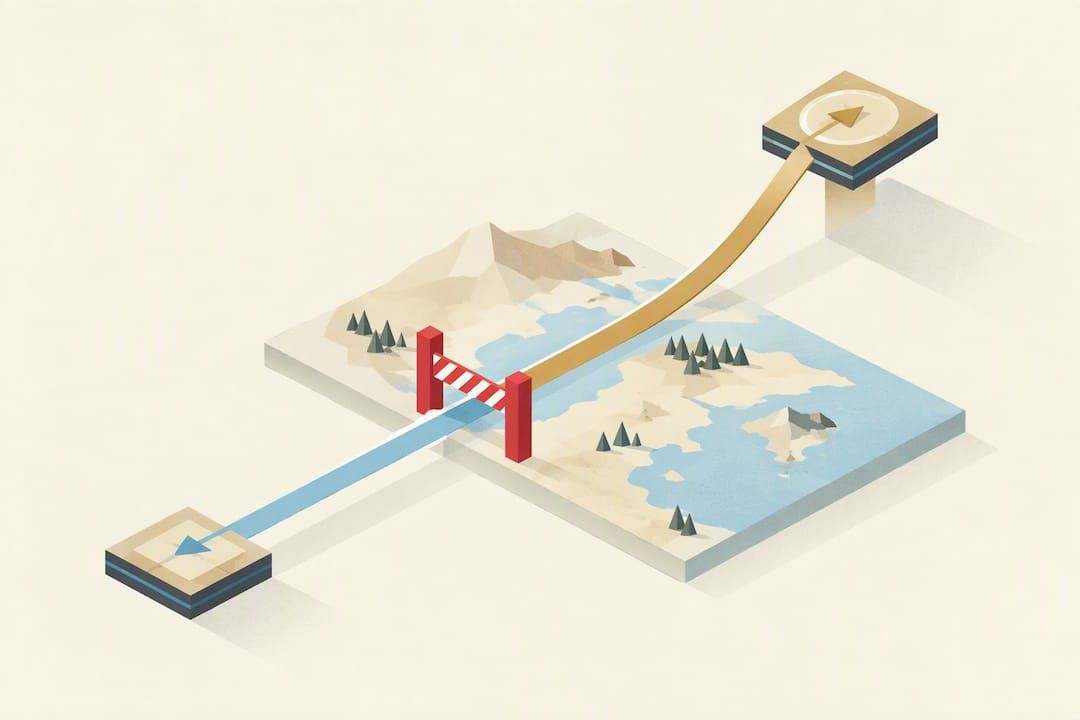
National parks close that door entirely in most cases. The NPS generally prohibits launching, landing, or operating drones anywhere inside park boundaries, and violations can bring criminal penalties up to six months in jail and a $5,000 fine. Special-use permits exist but require superintendent approval and rarely cover casual photography.
Helicopters operate under a completely different framework. Certified operators coordinate with air traffic control, hold commercial certifications, and can legally fly scenic routes over terrain a drone could never touch, which makes a reviewed Grand Canyon helicopter tour a genuinely legal path to images a drone pilot would face fines for attempting.
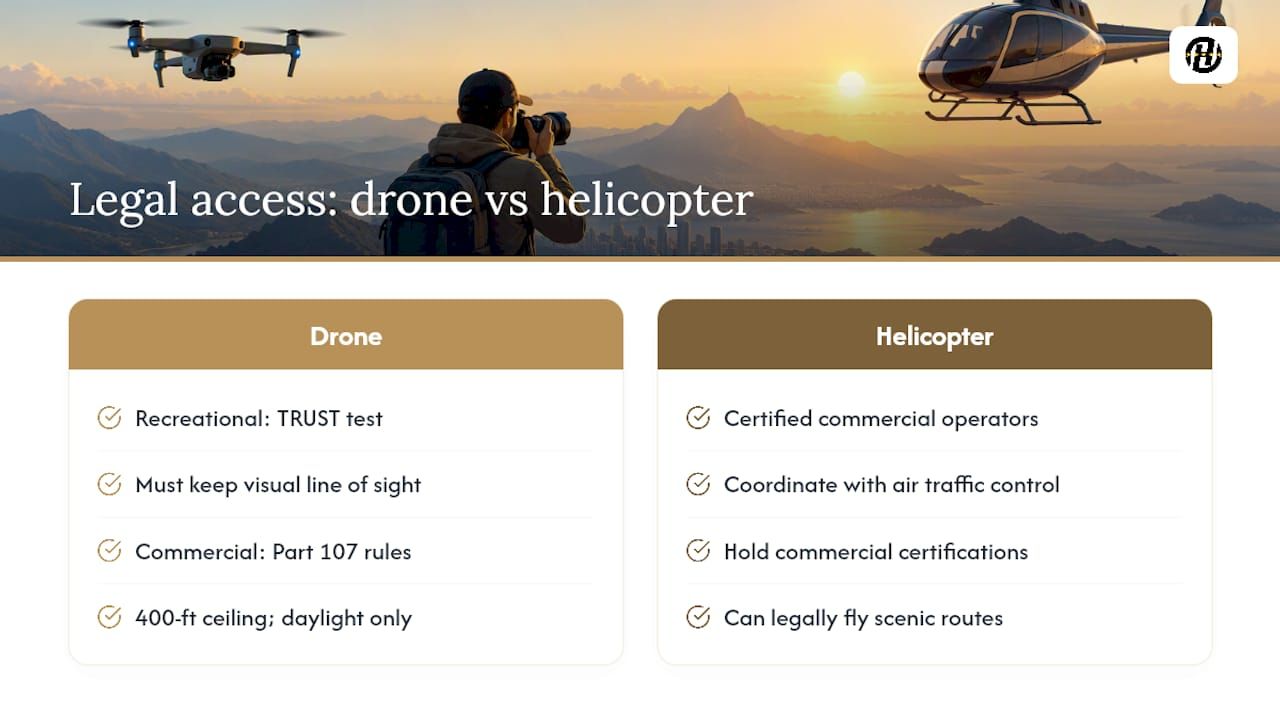
Pro Tip: Check the FAA’s airspace map before any drone flight, and if your destination is inside a national park boundary, skip the drone entirely and book a certified helicopter operator instead. It saves you a five thousand dollar mistake.
Shooting Tips That Raise Your Hit Rate on Either Platform
Preparation separates a folder full of keepers from a wasted flight, and the two platforms demand different prep.
For helicopters, decide early whether you want doors-off or doors-on. Shooting through glass creates reflections and contrast problems, while doors-off flights produce cleaner images but introduce strong wind and require your gear to be tethered. Wear dark, non-reflective clothing, keep your shutter speed at 1/500 or faster, and stick with that 24–105mm zoom for most of the flight.
For drones, plan your battery budget and shot order before takeoff so you’re not scrambling mid-flight. Carry ND filters for bright midday light, use smooth gimbal inputs instead of jerky stick movements, and practice on a simulator before you ever fly near a paying client’s property.
Editing matters just as much as capture. Straighten horizons first, recover shadow detail before pushing highlights, and favor vibrance over saturation so skin tones and water don’t turn cartoonish.
Pre-flight checklist for both platforms:
- Confirm airspace legality for your exact location
- Check weather and wind forecasts for your flight window
- Charge batteries or confirm helicopter fuel and crew availability
- Pack the right lens (wide for drone, 24–105mm for helicopter)
- Set shutter speed before takeoff, not mid-flight
Pro Tip: Shoot in RAW on both platforms. Aerial light shifts fast, and RAW files give you the latitude to fix exposure mistakes you won’t catch until you’re back on the ground.
What Drone and Helicopter Photography Actually Cost
Helicopter charters price by the hour, and that rate climbs with private bookings versus shared flights, plus any doors-off fee the operator charges for safety rigging. Expect longer lead times too, since you’re coordinating a certified pilot, insurance, and often air traffic clearance.
Drone missions look cheaper on paper. Equipment costs are lower, but hidden expenses add up: operator fees if you hire out the flight, permits for restricted airspace, and insurance that many venues now require before they’ll let you launch on their property.
Here’s where the math flips: a helicopter often becomes the more efficient choice for multi-location coverage, because one sortie can capture five sites a drone would need five separate trips to reach.
Before hiring any operator, confirm:
- Current liability insurance
- FAA commercial certification (Part 107 for drones, appropriate pilot certificates for helicopters)
- Verified experience with aerial photography, not just passenger flights
- Reviews from photographers specifically, not general tourists
Which Platform Fits Your Specific Shot List?
- Real estate listing: drone, low sweeps, repeat until the light’s right
- Travel hero shot for a magazine cover: helicopter, wider dynamic range, heavier lens support
- Documentary film with a cross-terrain establishing shot: helicopter, endurance wins
- Mapping or survey work: drone, precision and repeatability matter more than range
| Your Priority | Best Platform |
|---|---|
| Tight budget, repeatable shots | Drone |
| Protected land or national park | Helicopter |
| Heavy camera payload | Helicopter |
| Quick, low-altitude reveal | Drone |
Quick checklist: confirm your required camera spec, check whether your airspace is even legal for a drone, set your budget ceiling, and note how time-sensitive the light window is. When budget allows, layering a helicopter for wide coverage with drone passes for detail shots often beats picking just one.
Noise and Environmental Impact: The Trade-Off Nobody Advertises
Helicopters are loud, full stop. A single tour flight can disturb wildlife and residents alike within a wide radius, and fuel consumption for a piston or turbine engine is significant compared to an electric drone’s battery draw. That environmental cost is part of why national parks and other protected areas restrict low-altitude aircraft near sensitive habitats.
Drones look cleaner on the surface. They run on rechargeable batteries and produce a fraction of the noise at altitude, which is exactly why regulators still allow limited drone use in some non-park settings where helicopters would face community pushback. But drones carry their own quieter environmental cost: frequent battery cycling, e-waste from crashed or retired units, and disturbance to nesting birds when flown too close to cliffs or rookeries.
Neither platform is emission-free or silence-guaranteed. The practical takeaway for photographers is to treat noise and disturbance as a location-specific variable, not a fixed advantage for either aircraft. A helicopter tour operator flying established, wildlife-aware routes over open desert creates a very different impact than the same aircraft buzzing a coastal rookery at low altitude. Ask any operator, drone or helicopter, what routes and altitudes they use around wildlife before you book.
Weather Limits That Ground Drones and Helicopters Differently
Wind is the great equalizer, but it hits each platform differently. Most consumer and prosumer drones start struggling in sustained winds above 20 to 25 miles per hour, and gusty conditions near canyon walls or coastlines can make stable footage nearly impossible even below that threshold. Rain and drones simply don’t mix unless you’re flying specialized weatherproof hardware, which most photographers aren’t.
Helicopters tolerate more wind than drones, but they have their own ceiling. Pilots ground flights in heavy fog, low cloud ceilings, or severe turbulence, and doors-off flights get canceled first when wind speeds climb, since open-door shooting becomes a safety risk before it becomes an image-quality problem.
Both platforms depend heavily on visibility for the kind of shot most photographers actually want: crisp horizons and clean light. Haze, wildfire smoke, and low cloud cover can flatten contrast on even a perfectly framed shot, no matter which aircraft you’re in. Building a flexible shoot date, or booking a tour operator with a generous weather rebooking policy, matters more than most first-time aerial photographers expect.
Safety Practices Every Aerial Photographer Should Know
Drone safety starts with airspace awareness. Flying near airports, wildfires, or crowds isn’t just risky, it’s often illegal under Part 107 or the recreational TRUST rules, and losing GPS lock mid-flight over water or rugged terrain can turn a fun shoot into an expensive search for a lost aircraft.
Helicopter safety carries higher physical stakes for the photographer, particularly on doors-off flights. Gear needs to be tethered with a real safety strap, not just a camera wrist strap, since a dropped lens at altitude is a hazard to anyone below. Reputable operators require harnesses for doors-off passengers and brief every photographer on what not to do, like leaning out further than the harness allows or reaching for a dropped item mid-flight.
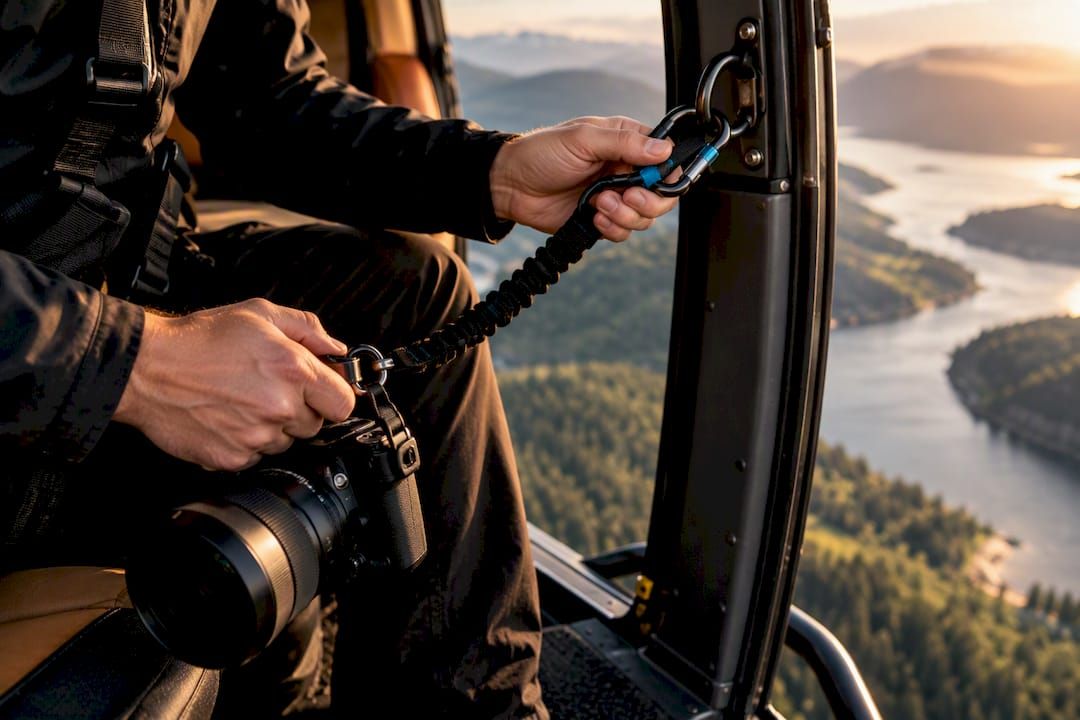
The common thread across both platforms is that the operator’s safety culture matters as much as your own preparation. A verified, insured, FAA-certified operator has already solved most of the risk equation before you ever board or launch. That’s a meaningfully different starting point than a bargain flight with no visible safety briefing.
Permits and Authorizations Beyond the Basic Drone Rules
Part 107 covers the baseline for commercial drone flight, but it isn’t the only permission you might need. Flying over certain federal lands, tribal lands, or state parks can require a separate permit even when Part 107 technically allows the flight, and local ordinances in some cities add another layer of restriction on top of federal rules.
Helicopter photography has its own permission stack. Flying over private property at low altitude, landing outside a certified helipad, or operating near restricted airspace, like near a military installation or major airport, requires coordination well beyond a standard sightseeing charter. Reputable operators handle this coordination as part of booking, which is exactly why working with a certified operator with an established safety record saves photographers from navigating a permitting maze alone.
The practical rule: never assume a Part 107 certificate or a standard helicopter charter automatically clears you for a specific location. Confirm with the operator, the land manager, or the FAA’s airspace tools before you book, especially if your shot list includes anything near a park boundary, a restricted zone, or private land you don’t have written access to.
Why the Real Decision Isn’t Drone vs. Helicopter at All
Most articles frame this as a binary choice, and that framing misses what actually happens on working shoots. Helicopterstour reviews over 1,000 helicopter tours across dozens of destinations and independently verifies FAA-certified operators against thousands of traveler reviews, and that verification process exists because the gap between a mediocre helicopter flight and a genuinely photo-ready one is enormous.
The site’s tour filters surface doors-off options and location-specific reviews, which matters more than most photographers realize until they’ve booked a flight only to discover the windows don’t open. Pairing that kind of verified access with sound drone technique rather than treating one platform as universally superior is what actually produces a strong aerial portfolio.
— Justin
Book a Verified Helicopter Tour Built for Photographers
Once you’ve decided a helicopter fits your shot list better than a drone, the next problem is finding an operator who actually understands what photographers need, doors-off access, honest reviews from people who’ve flown with a camera in hand, not just tourists on a sightseeing loop. That’s the gap Helicopterstour closes. The site lists operators with information about FAA certification, and the review data comes from travelers rather than marketing copy.

Search the Helicopterstour landing page by destination to filter for tours with doors-off availability and strong photography reviews, whether you’re chasing canyon light in the Southwest or a skyline shot over New York’s helicopter tour routes. If you’re weighing a private charter against a shared flight for better camera access, the site’s breakdown of private versus shared bookings will help you pick the format that gets you the seat and window you actually need. Check availability for your target dates and book directly through the verified listings.
Sources
- NPS — Unmanned aircraft in the national parks
- FAA — Recreational UAS operations (TRUST and rules)
- Drone vs Helicopter – Which is Best? — Lensaloft
- The-digital-picture
FAQ
Are Drones Legal in National Parks?
No, in most cases. The NPS generally prohibits launching, landing, or operating drones inside park units, and violations can bring fines up to $5,000 and jail time up to six months.
What Shutter Speed Should I Use for Helicopter Photos?
Use 1/500 of a second or faster, ideally up to 1/1000, to counter aircraft vibration and wind movement during doors-off flights. Slower speeds risk motion blur even with a steady hand.
Do I Need a License to Fly a Drone for Photos?
Recreational flyers need to pass the TRUST test, while anyone shooting for pay or a client falls under Part 107 commercial rules. Both require staying within visual line of sight and under the 400-foot altitude ceiling.
Is a Helicopter or Drone Better for Landscape Photography?
It depends on the terrain and access. Helicopters handle wide, cross-terrain landscapes and protected land better, while drones excel at close, repeatable shots in open, legal airspace.
How Do I Find a Reliable Helicopter Photography Tour?
Look for operators with verified FAA certification and reviews from photographers, not just sightseers. Helicopterstour independently checks operator credentials and traveler reviews across its listed tours to help you filter for photo-friendly, doors-off options.
Recommended
- Amazing Save the Date: Photoshoot in Istanbul with Helicopter Review 2026
- Scenic Lakeside Proposal with Luxury Helicopter from NYC – Tour Recap and Review
- Top 8 Best Wedding and Proposal Helicopter Tours