

Most scenic helicopter operators cap individual passengers around 240 to 300 pounds per seat, with occasional exceptions on certain aircraft. Combined passenger weight for a small tour helicopter typically tops out within a range generally set by operators. You’ll almost always be weighed at check-in, and going over a limit usually means an extra-seat fee or a bump to a bigger aircraft. Call the operator before you book to confirm their exact numbers.
TL;DR:
- Most helicopter operators set individual seat weight limits between 240 and 300 pounds, with larger cabins sometimes allowing higher limits.
- Combined passenger weight limits typically range from 500 to 700 pounds, depending on the aircraft size and configuration.
- Passengers are weighed at check-in on calibrated scales, and exceeding the limit often results in extra-seat fees, rebooking, or upgrading to a larger helicopter.
- External factors like fuel burn, high temperatures, and altitude can reduce payload allowance, especially for smaller, lighter aircraft.
- Calling ahead to confirm weight policies and planning for private or split flights can prevent last-minute issues for groups near weight thresholds.
Table of Contents
- How Much Do Helicopter Tour Weight Limits Actually Run?
- Why Do Helicopters Even Have Weight Limits?
- What Happens at Check-In When You’re Weighed?
- How Do Fuel, Weather, and Altitude Change the Limit?
- What Should You Do If Your Group Might Be Over the Limit?
- How Helicopterstour Checks Operator Weight Policies
- A Safety Measure, Not a Judgment Call
- Find a Tour That Fits Your Group Without the Guesswork
- Sources
- FAQ
How Much Do Helicopter Tour Weight Limits Actually Run?
Weight limits vary by aircraft, but the pattern across the industry is consistent enough to plan around. A single seat rarely goes below approximately 240 pounds, and 250 to 300 pounds is the typical range you’ll see quoted on operator FAQs and booking pages. A few operators flying larger cabins allow somewhat higher limits per seat, though that’s the exception, not the rule.
Combined weight matters just as much as any single passenger’s number, because helicopters are certified against total payload, not just per-seat caps.
- A three-seat Robinson R44 configuration often caps combined passenger weight around 500 to 600 pounds.
- Four-seat variants used for scenic tours frequently allow 600 to 700 pounds total across all passenger seats.
- Larger six-seat class helicopters can stretch combined limits higher, but pricing and availability shift accordingly.
Quick math helps here: if your group of three averages 200 pounds each, you’re at 600 pounds combined. That’s fine for many four-seat aircraft but could push a three-seat R44 close to its ceiling. Operator data compiled by Jettly shows this kind of combined-weight math is exactly what trips up groups who never checked in advance.
Why Do Helicopters Even Have Weight Limits?
The short answer: physics and federal law both demand it. Helicopters aren’t just heavier versions of a car with a maximum trunk load. Every pound affects lift, balance, and how the aircraft handles in flight.
§ 27.25 of the Federal Aviation Regulations governs how rotorcraft manufacturers establish maximum and minimum weights during certification, and it assumes an occupant weight of 170 pounds per seat unless a different figure is specifically requested. That 170 pound baseline is a certification assumption, not a real-world passenger cap, which is exactly why operators publish their own tighter, more realistic limits.
Center of gravity matters as much as raw pounds. A helicopter loaded unevenly, even under its total weight limit, can become difficult or dangerous to control. That’s why seating charts aren’t arbitrary, and why the pilot in command has final authority to refuse a flight, reassign seats, or require a different aircraft if the load doesn’t check out. Regulatory language sets the outer framework. The operator’s day-to-day policy, built around a specific aircraft, route, and set of conditions, is what actually governs your booking.
What Happens at Check-In When You’re Weighed?
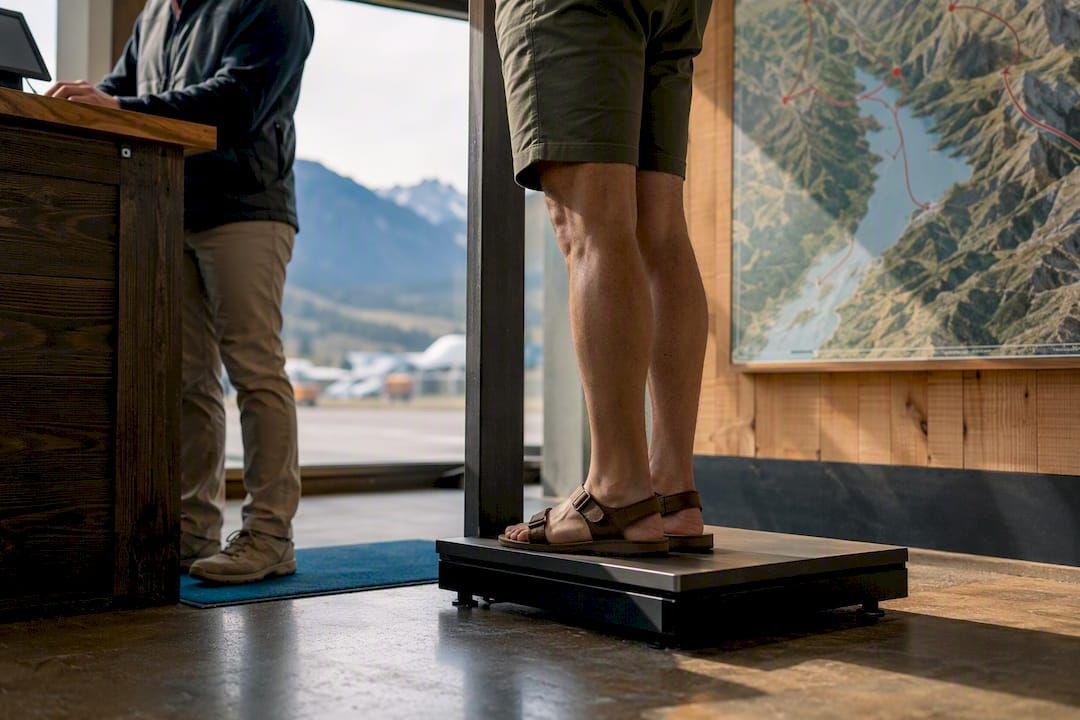
Expect a calibrated scale, not a guess. Reputable operators weigh every passenger before boarding, and some run random spot checks even on returning customers who’ve flown before. Here’s the typical sequence:
- You check in and provide your estimated weight during booking or by phone.
- Staff verify that number on a calibrated scale at the heliport.
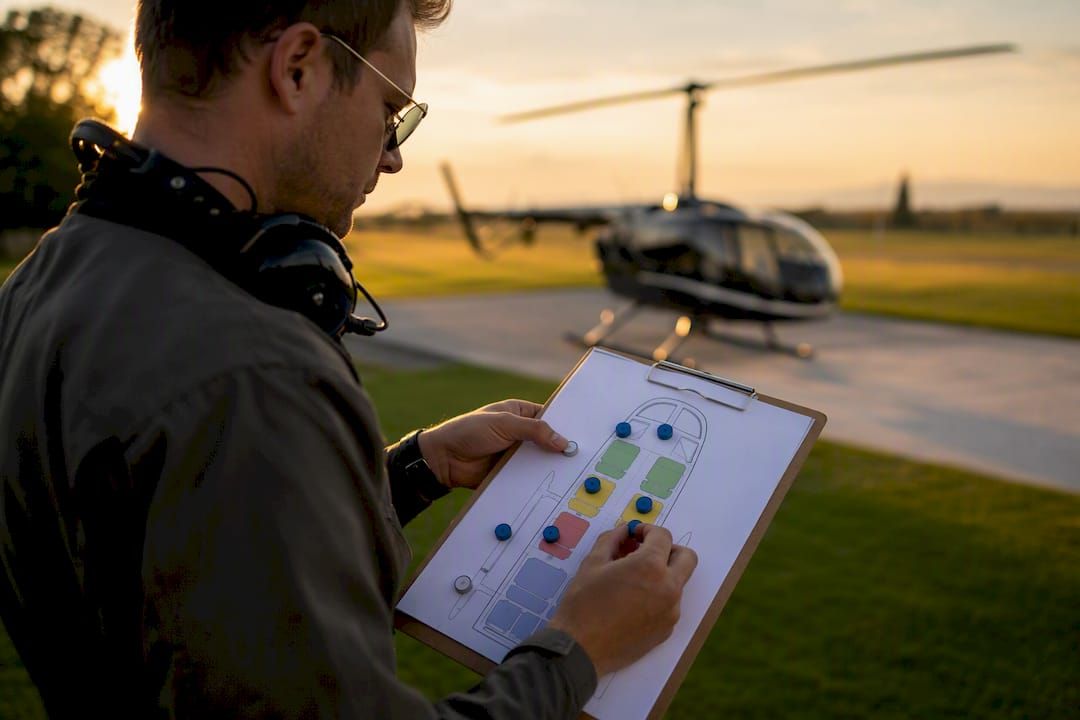
- The team assigns seats based on total weight and balance, not just headcount.
- If your actual weight exceeds what you booked for, staff will discuss extra-seat purchase, rebooking, or a different aircraft.
Fees for exceeding a per-seat limit commonly run as an extra-seat purchase, similar to what you’d see itemized in a FareHarbor booking flow where add-on seats are priced and selected during checkout. Other operators use a flat surcharge band instead.
Pro Tip: If you’re uncomfortable being weighed in front of other passengers, call ahead and ask whether the operator offers a private check-in area. Most will accommodate this without hesitation.
How Do Fuel, Weather, and Altitude Change the Limit?
The weight limit you see advertised isn’t fixed. It shifts based on conditions that have nothing to do with the aircraft’s paperwork.
- Longer tours burn more fuel, and fuel itself has weight, so a 90-minute flight leaves less payload allowance than a 20-minute loop over the same route.
- Hot temperatures and high elevation both thin the air, which reduces the lift a rotor can generate. Pilots call this the “hot and high” effect, and it’s why the same helicopter might carry fewer passengers on a 95-degree afternoon than on a cool morning.
- Aircraft class sets the outer boundary: light scenic helicopters like the R44 have the tightest payload margins, intermediate single-engine turbines allow more flexibility, and larger twin-engine models used for longer or higher-altitude routes carry the most forgiving limits.
Booking a morning or sunset flight during cooler hours can sometimes make a meaningful difference on marginal days, particularly at higher-elevation departure points.
What Should You Do If Your Group Might Be Over the Limit?
Don’t wait until you’re standing on the scale to find out. A few phone calls ahead of time solve most weight-related headaches before they start.
Your main options if the numbers look tight:
- Purchase a second seat for a passenger who exceeds the per-seat limit.
- Upgrade to a larger helicopter or book a private charter instead of a shared flight.
- Split a larger group across two flights.
- Reschedule for a cooler time of day if you’re near a hot-and-high threshold.
- Ask directly whether the operator has any flexibility given your specific circumstances.
Before you call, run through this checklist:
- Weigh yourself within 48 hours of your flight for an accurate number.
- List any gear, camera equipment, or mobility aids you’ll bring aboard.
- Ask for both the per-seat limit and the combined limit for your specific aircraft.
- Confirm the scale policy: public, private, or self-reported with spot checks.
- Request your seating assignment in advance if your group has a wide weight range.
Pro Tip: Extra-seat fees typically run in the range of one additional ticket price, while a full private charter upgrade can cost more but eliminates weight anxiety entirely for combined-weight groups approaching 700 pounds.
How Helicopterstour Checks Operator Weight Policies
Helicopterstour verifies FAA-certified operators and reviews their published policies before featuring a tour, rather than relying on marketing copy alone. That verification process, combined with analysis of traveler feedback, surfaces the same patterns again and again: mandatory weighing at check-in, per-seat thresholds clustering around 250 to 300 pounds, and a consistent industry practice of offering an extra seat rather than turning a passenger away outright.
The recurring advice from traveler reports is simple. Ask for the operator’s exact scale policy before you pay a deposit, get your seating confirmation in writing, and confirm what happens to your payment if a reschedule becomes necessary. Groups that ask these questions upfront report far fewer surprises at the heliport.
A Safety Measure, Not a Judgment Call
Weight checks can feel personal, and I understand why some travelers dread stepping on a scale in front of strangers. But the pilot in command isn’t making a judgment. They’re making a calculation about lift, balance, and everyone’s safety on board, including yours.
The best approach is transparency, and it costs you nothing. Call the operator early, give an honest estimate, and ask questions before you’ve committed money to a flight time that might not work for your group. Travelers who plan this way, including nervous flyers worried about more than just the scale, consistently report smoother, less stressful check-ins.
— Justin
Find a Tour That Fits Your Group Without the Guesswork
Calling operator after operator to compare weight policies eats up hours you’d rather spend planning the trip itself. Helicopterstour does that legwork for you: every listed operator is FAA-certified and vetted, with weight policies and seating details laid out clearly instead of buried in fine print.

If your group’s combined weight is pushing toward a shared-flight ceiling, browsing private charter options solves the problem outright, since a private booking sidesteps per-seat limits tied to shared configurations. Start by browsing verified helicopter tours on Helicopterstour and filter for the capacity and aircraft type that actually fits your group, then confirm the operator’s exact weight policy directly before you book.
Sources
For the regulatory framework, review 14 CFR § 27.25 directly. Operator booking flows, including seat and add-on pricing, are visible in embeds like the one used by Paradise Helicopters.
- § 27.25 – Weight limits. — Code of Federal Regulations (14 CFR 27.25)
- Weight limit for helicopter ride: What you need to know before you book — Jettly
- FareHarbor booking embed — Scenic Helicopter Tours (booking embed)
FAQ
What is the weight limit for helicopter rides?
Most operators cap individual seats generally in the range of 240 to 300 pounds, with combined passenger limits for small scenic helicopters varying based on aircraft type.
Do you have to give your weight for a helicopter ride?
Yes. Nearly all operators require an estimated weight at booking and verify it with a calibrated scale at check-in to maintain balance and stay within certified limits.
How much weight is allowed in a helicopter?
Total allowed weight depends on the specific aircraft, fuel load, and conditions that day, but small scenic helicopters generally allow 550 to 700 pounds of combined passenger weight, per industry reporting.
Does a helicopter have a weight limit?
Every helicopter has both a per-seat limit and a combined payload limit set during certification under FAA regulations, then narrowed further by each operator’s own safety policy.
What if I’m pregnant or traveling with a mobility aid?
Policies vary by operator, so check family and accessibility guidance and call ahead to confirm any restrictions or accommodations specific to your situation before booking.
Recommended
- What to Wear on a Helicopter Tour: Clothing, Camera, Comfort Tips
- Are Helicopter Tours Worth It for Families and Kids? Safety, Age Limits and Tips
- Can You Take a Helicopter Tour If You’re Afraid of Heights? Tips for Nervous Flyers