

Part 135 is the FAA regulation that governs on-demand commercial flying, including most helicopter tours and air taxi service, and it applies to on-demand commercial aircraft typically configured with small passenger capacities and payload limits. It requires far tighter safety oversight than flying privately: approved maintenance programs, trained and checked pilots, and regulated duty and rest limits. The company operating the flight, not the aircraft owner, holds the certificate and answers to the FAA for every trip.
TL;DR:
- Most helicopter tour operators must hold a Part 135 certificate, which requires FAA-approved maintenance, regulated pilot training, and strict operational oversight.
- Certification involves a multi-stage process including manual submission, FAA inspection, and management personnel validation, which can take several months.
- The operator’s specific operational scope is detailed in their OpSpecs, which should be verified before booking to ensure compliance and safety standards.
- Helicopter-specific rules within Part 135 include advanced safety equipment like terrain awareness systems and higher weather minimums, especially for air ambulance operations.
- Checking an operator’s FAA certification and OpSpecs directly or through verified listings helps ensure the tour provider adheres to the legal safety requirements.
Table of Contents
- What Is Part 135 and Who Does It Apply To?
- Core Operational Requirements Under Part 135
- How to Get Certified Under Part 135
- Part 135 vs Part 91 vs Part 121: The Regulatory Ladder
- Helicopter-Specific Rules and Air Ambulance Requirements
- Hazmat, Security, and Insurance Expectations
- Operational Control and What Real Oversight Looks Like
- How to Verify a Part 135 Operator Before You Book
- Why Part 135 Matters More Than Most Travelers Realize
- Skip the Regulatory Homework and Book a Vetted Tour Instead
- Primary Sources Worth Bookmarking
- Sources
- FAQ
What Is Part 135 and Who Does It Apply To?
Part 135 draws a line between flying for fun and flying for hire. Anyone selling seats or charter capacity to the public, from a jet management company to a helicopter tour outfit over the Grand Canyon, generally has to hold a Part 135 certificate to operate legally.
The FAA’s applicability threshold caps Part 135 at aircraft with 30 or fewer passenger seats or 7,500 pounds of payload capacity or less. Larger aircraft move into Part 121, the rulebook for scheduled airline service. Within Part 135, operators fall into a few distinct categories:
- On-demand operators fly charter trips without a published schedule, which covers most sightseeing and tour helicopters.
- Commuter operators run scheduled service on smaller aircraft, often between regional airports.
- Single-pilot operators work under a reduced scope suited to smaller fleets and simpler aircraft.
Certificates also come in two flavors. An air carrier certificate covers operators flying interstate or in foreign commerce; an operating certificate covers those flying purely within one state. Either way, the certificate spells out exactly what kind of flying that operator is legally allowed to do.
Core Operational Requirements Under Part 135
This is where Part 135 earns its reputation as the tougher standard. The FAA’s Part 135 overview lays out four pillars that separate commercial charter flying from private flying under Part 91:
- Maintenance: aircraft follow an FAA-approved inspection program, not just the manufacturer’s suggested schedule.
- Pilot training: crews complete recurrent training and competency checks on a set cadence, not whenever convenient.
- Duty and rest limits: flight and duty time are capped by regulation, which caps how tired a pilot legally can be at the controls.
- Operational control: the certificate holder, not the aircraft owner, decides whether a flight goes.
Every Part 135 certificate comes with operations specifications, known as OpSpecs, which function like a customized rulebook for that specific operator. OpSpecs list exactly which aircraft, routes, weather minimums, and types of operations that company is authorized to fly. Two operators flying the same helicopter model can have meaningfully different OpSpecs.
Pro Tip: Ask an operator to name their OpSpec authorizations before you book. A company that hesitates or gives a vague answer likely isn’t managing that paperwork closely.
How to Get Certified Under Part 135
Certification is a multi-month organizational project, not a form you fill out. The FAA’s general certification requirements walk applicants through a five-stage process:
- Pre-application: define the scope of operations (aircraft type, geography, on-demand versus commuter) and meet informally with the FAA.
- Formal application: submit ownership and citizenship documentation, along with proof of a dedicated principal base of operations.
- Document compliance: build and submit an operations manual, an approved maintenance program, and hazmat and drug-and-alcohol testing programs.
- Demonstration and inspection: the FAA conducts proving tests and inspections to confirm the paper program matches real-world practice.
- Certification: OpSpecs are issued and the operator can begin revenue flights within the approved scope.
Applicants also need named management personnel, including a director of operations and a chief pilot, before the FAA will move forward. None of this happens quickly, and operators who rush the document stage tend to stall out at inspection.
Part 135 vs Part 91 vs Part 121: The Regulatory Ladder
Think of Parts 91, 135, and 121 as three rungs on the same ladder, with oversight increasing at each step as the scale of commercial risk grows. FAA rulemaking context frames it exactly this way: more paying passengers means more regulatory scrutiny.
- Part 91 governs private, noncommercial flying. There’s no requirement for an approved maintenance program, no mandated duty/rest tracking, and the pilot in command can often make the go/no-go call alone.
- Part 135 adds FAA-approved maintenance, recurrent training, regulated rest, and operational control resting with a certificate holder.
- Part 121 governs scheduled airlines, with even stricter equipment, weather-minimum, and crew-staffing rules than Part 135.
For passengers, the practical takeaway is simple: if you’re paying for a seat on a helicopter tour or an air taxi flight, you should expect Part 135 protections. If a flight is being offered informally or through a private arrangement, ask directly which part it operates under, since Part 91 vs Part 135 distinctions affect everything from pilot minimums to whether the aircraft gets independently inspected.
Helicopter-Specific Rules and Air Ambulance Requirements
Rotorcraft carry their own subpart within Part 135, largely because helicopters fly closer to terrain and obstacles than fixed-wing aircraft. Requirements include:
- HTAWS (helicopter terrain awareness and warning systems) to reduce controlled-flight-into-terrain accidents.
- Radio altimeters for more precise altitude awareness near ground level.
- Higher weather minimums and mandatory survival equipment for overwater operations.
Helicopter air ambulance operators face additional layers, including instrument rating requirements for pilots and operations control centers for larger fleets. These provisions trace back to a 2014 Federal Register rule written specifically in response to a string of HAA accidents, and they now shape safety expectations across sightseeing and tour operators too.
Hazmat, Security, and Insurance Expectations
Most Part 135 carriers need an FAA-approved hazardous materials program, referencing standards under 49 CFR Parts 100 through 185 and ICAO Technical Instructions. This applies even to operators who never intentionally carry hazmat, since crew and ground staff still need to recognize undeclared dangerous goods.
- TSA security programs kick in based on aircraft size and type of operation, with larger or interstate operators facing more formal screening requirements.
- Insurance should be confirmed directly, since Part 135 certification alone doesn’t guarantee a specific coverage level.
- DOT economic authority becomes relevant for operators running interstate commuter service, layered on top of FAA safety certification.
Operational Control and What Real Oversight Looks Like
Operational control is the legal hinge of Part 135. The certificate holder, not the person who owns the helicopter, decides whether a flight is safe to launch, and that accountability is what operational control provisions are designed to enforce.
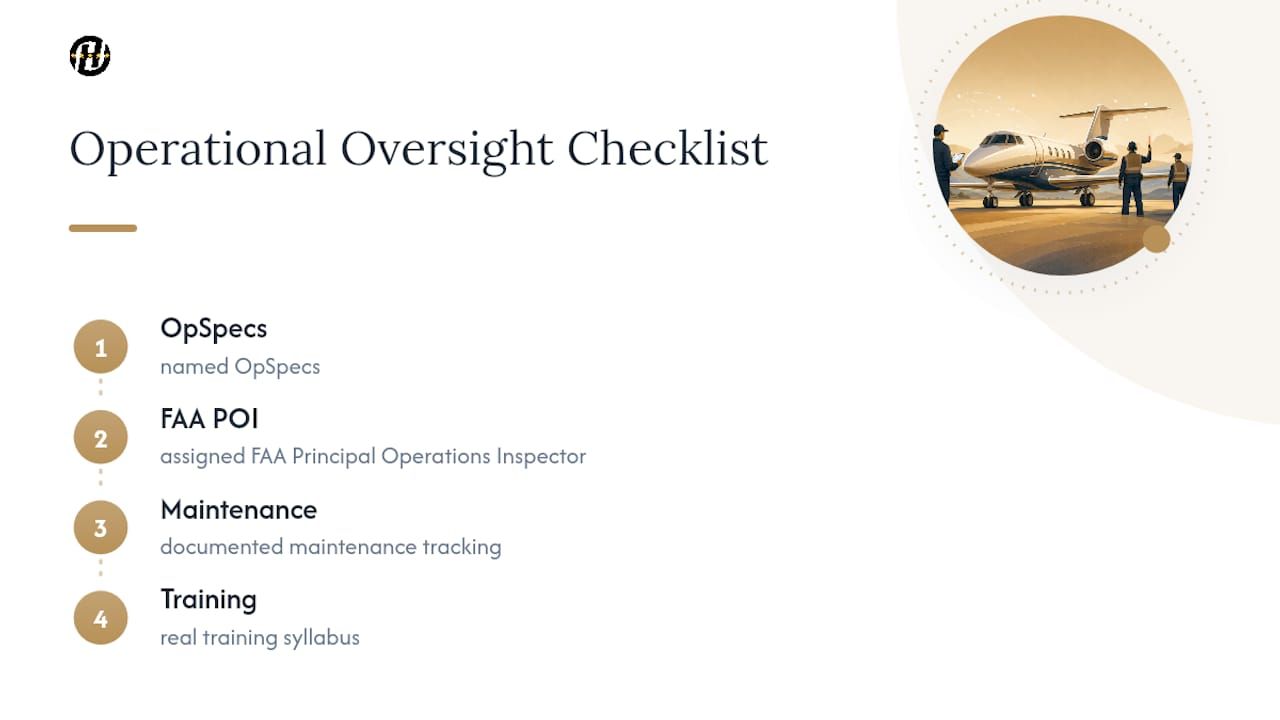
Genuine oversight leaves a paper trail: named OpSpecs, an assigned FAA Principal Operations Inspector (POI), documented maintenance tracking, and a real training syllabus. When Helicopterstour reviews an operator, checking that this trail actually exists is part of how we’ve helped guide over 50,000 travelers toward tours with a 4.9-star average rating, rather than just a nice-looking listing.
How to Verify a Part 135 Operator Before You Book
A few direct questions separate a legitimate operator from one hoping you won’t ask.
- Check FAA records. Look up the operator’s certificate and OpSpecs through FAA or eCFR public resources before handing over payment.
- Ask about maintenance. A real operator names its approved inspection program without hesitation.
- Ask about training cadence. Recurrent training and checkride schedules should be specific, not vague.
- Ask who their POI is. Every certificated operator has an assigned FAA inspector; not knowing that name is a red flag.
- Confirm hazmat and insurance basics. Even a simple, confident answer beats silence.
If any answer feels evasive, that’s worth weighing against the tour’s price and reviews. Our helicopter tour safety guide walks through additional questions worth asking before you fly.
Why Part 135 Matters More Than Most Travelers Realize
Most passengers booking a sunset helicopter tour never think to ask what certificate the operator holds, and that’s exactly the information gap Part 135 exists to close. Regulators built this framework because a paying passenger can’t independently inspect an aircraft’s maintenance logs or sit in on a pilot’s last check ride.
Helicopterstour’s review process leans on that same logic: cross-checking FAA certification against thousands of traveler experiences before recommending a tour. Certification alone doesn’t guarantee a great flight, but it’s the floor every legitimate operator has to clear, and our private versus shared tour guide breaks down how that floor affects your options once you’re ready to choose.
— Justin
Skip the Regulatory Homework and Book a Vetted Tour Instead
Verifying an operator’s certificate, OpSpecs, and maintenance record yourself takes real time, and most travelers would rather spend that time picking a route than reading FAA filings. Helicopterstour does that verification work upfront, cross-referencing FAA-certified operators against thousands of traveler reviews before a tour ever appears in our listings.

That means when you’re browsing options like a doors-off flightseeing tour over Kauai or comparing city sightseeing routes, the certification check has already happened. Start with our best helicopter tours reviewed for 2026, or if New York is on your list, take a look at the top New York helicopter tours and book directly through a listing that’s already passed our operator checks.
Primary Sources Worth Bookmarking
For readers who want the regulatory text itself rather than a summary, these are the primary sources this article draws from:
- 14 CFR Part 135 on eCFR: the full codified operating requirements.
- FAA Part 135 overview: plain-language summary of charter-type services.
- FAA certification general requirements: the documentation checklist for applicants.
- 2014 Federal Register HAA rule: the rulemaking behind helicopter air ambulance safety measures.
Sources
- Charter‑Type Services (Part 135) — FAA
- eCFR: 14 CFR Part 135 — Operating requirements
- FAA — Part 135 certification general requirements
- Federal Register: Part 135 helicopter air ambulance final rule (2014)
FAQ
What Is the Difference Between Part 135 and Part 121?
Part 135 covers on-demand and commuter operators flying smaller aircraft with passenger and payload limits that distinguish them from scheduled airline operations, while Part 121 governs scheduled airlines with stricter crew, equipment, and weather-minimum requirements.
What’s the Difference Between Part 91 and Part 135?
Part 91 governs private, noncommercial flying with no requirement for an approved maintenance program or regulated crew rest, while Part 135 mandates FAA-approved maintenance, recurrent pilot training, and operational control resting with a certificate holder.
How Many Hours Do You Need for Part 135?
Specific hour minimums vary by operation type and are set through each operator’s OpSpecs rather than a single fixed number, though Part 135 pilots generally face higher experience and recurrent training standards than Part 91 pilots.
Who Does Part 135 Apply To?
Part 135 applies to any operator selling on-demand or commuter commercial flights on aircraft with 30 or fewer seats or 7,500 pounds of payload or less, including most helicopter tour and air taxi companies.
How Can I Check if a Helicopter Tour Operator Holds a Part 135 Certificate?
You can look up an operator’s certificate and OpSpecs through FAA public resources, or check whether the tour is listed on a site like Helicopterstour that verifies FAA certification before publishing a review.