

Hey there, I’m Justin. One of the questions I get asked constantly, right up there with pricing and safety, is what a flight actually looks like once you’re airborne. That’s exactly what good helicopter tour videos are for — they show you the real thing before you ever book a seat, rather than leaving you to guess based on a few stock marketing photos. Whether you’re trying to decide if a doors off helicopter tour video is worth the extra wind and noise, or you’re planning to film your own flight and want real helicopter tour video tips before you go, this guide covers what’s actually worth knowing.
Key Takeaways
- Real flight footage shows conditions, camera angles, and pacing that marketing photos never capture.
- Doors-off flights are governed by a 2018 FAA order requiring quick-release, FAA-approved restraints for every passenger.
- Wide field-of-view settings and higher frame rates generally produce the smoothest, most usable helicopter footage.
- Action cameras typically record for 45 minutes to just over an hour on a full charge, depending on resolution and frame rate.
- Watching real operator footage ahead of time is one of the best ways to set expectations before booking.
Jump to a Section
- What Makes Helicopter Tour Footage So Different
- What to Expect Before You Start Filming
- Doors-Off Flights and Filming Gear
- Camera Settings and Battery Life
- Smartphone vs. Action Camera vs. Professional Footage
- Where to Watch Real Helicopter Tour Videos Before You Book
- Sharing and Reliving Your Flight
- Insider Tips from Justin
What Makes Helicopter Tour Footage So Different
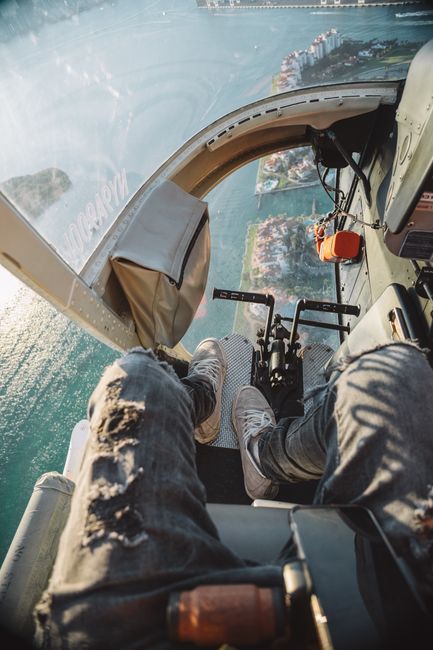
Drone footage and helicopter footage look similar at a glance, but they’re not really the same thing. A drone is small, silent, and can hover in place for a perfectly composed shot. A helicopter is moving at real speed, carrying real weight, and constantly banking and repositioning to give passengers the best angle on whatever’s below. That difference shows up clearly in helicopter tour videos — there’s a sense of scale and momentum that a hovering drone shot just doesn’t replicate, because you’re watching footage captured from inside a moving aircraft rather than a remote-controlled camera platform.
It also means the footage tends to include things a polished marketing video would cut out — the initial vibration on takeoff, a passenger’s reaction in the corner of frame, the shift in light as the aircraft banks into a turn. Those details are exactly why unscripted helicopter tour videos tend to set expectations better than a highlight reel; they show you what the ride actually feels like, not just what the destination looks like from a flattering angle.
That’s also why so many operators now lean on real footage in their own marketing rather than relying purely on photography. A short clip of an actual flight, cabin sounds and all, tends to build more trust with a hesitant first-time flyer than a dozen polished stills ever could, which is a big part of why helicopter tour videos have become such a standard part of how tours get marketed and researched today.
What to Expect Before You Start Filming
Most of the anxiety first-time flyers feel comes from not knowing the sequence of events, and that uncertainty shows up in their footage too — shaky opening shots, a camera pointed the wrong way during boarding, footage that starts ten minutes too late. Arriving with a rough plan for what you’ll film, and when, makes a noticeable difference in the final result.
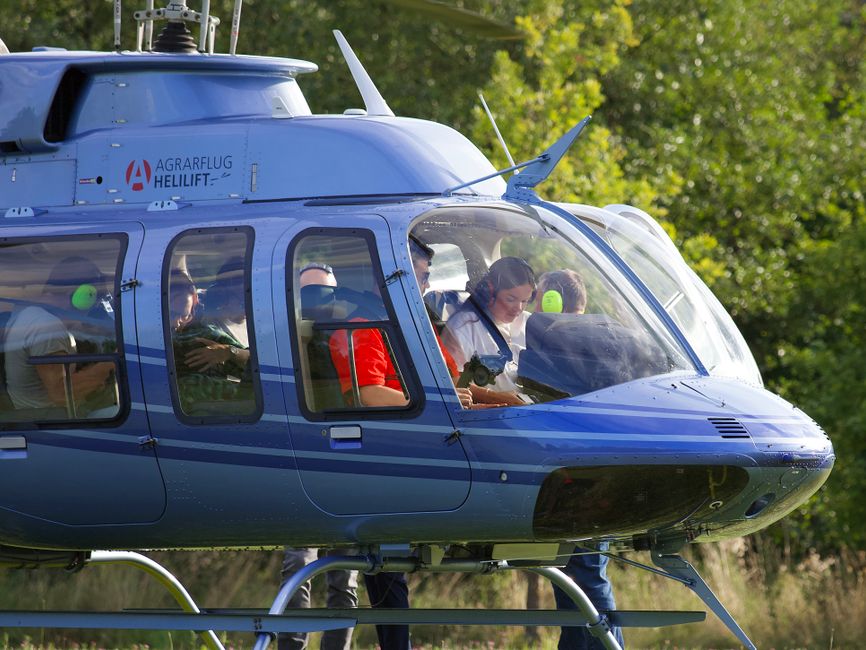
Check-in typically happens 15 to 20 minutes before departure, followed by a weight and balance briefing and a walk-through of headset and safety equipment. That’s actually a great window to capture some establishing footage: the aircraft on the ground, the briefing itself, and the walk out to board. It gives any video you put together afterward a proper beginning instead of starting mid-flight with no context.
One of the simplest helicopter tour video tips costs nothing and takes thirty seconds: ask your pilot or ground crew which side of the aircraft will face the best scenery on your specific route. Routes aren’t always symmetrical, and knowing in advance which window or door to favor saves you from filming the wrong side for the first five minutes of the flight.
Doors-Off Flights and Filming Gear
A doors off helicopter tour video tends to look noticeably better than the same flight shot through glass, since there’s no window reflection, tint, or scratched acrylic softening the shot. It’s also, understandably, one of the more tightly regulated configurations in the industry. Following several serious incidents, the FAA issued an emergency order in 2018 prohibiting commercial doors-off flights unless every passenger is secured with a restraint that’s both FAA-approved and can be released quickly, without tools or outside assistance, in an emergency.
That regulation directly shapes how you’re allowed to film. Any camera setup for a doors off helicopter tour video needs to be secured to you, not dangling loose or extended out past the aircraft, since anything untethered becomes a genuine hazard the moment the aircraft banks. A short handheld stick with a wrist strap is the standard, safe approach — long selfie sticks or anything that requires reaching outside the cabin generally aren’t allowed, and for good reason.
If your operator offers both configurations, it’s worth deciding in advance rather than choosing on the spot. A standard closed-cabin flight is quieter, calmer, and still produces a perfectly good helicopter tour video, while the doors-off version trades some comfort for a genuinely unobstructed shot.
Operators that regularly run a doors off helicopter tour video configuration tend to have this process down to a routine, with clear pre-flight instructions about mounting, securing, and stowing gear before the doors ever come off. If an operator seems vague or improvised about that briefing, it’s worth treating that as a signal about their overall attention to safety procedure, not just their filming setup.
Camera Settings and Battery Life
For actual helicopter tour video tips, start with field of view. Shooting as wide as your camera allows captures more of the landscape in frame, which matters enormously on a flight where the whole point is scale. A higher frame rate, commonly 60fps, is also worth using where your camera and storage allow it, since it gives you the option to slow footage down in editing without it looking choppy.
Battery life is the other practical constraint worth planning around. Depending on the camera model, resolution, and frame rate chosen, GoPro’s own published battery specifications show recording times ranging from roughly 45 minutes at the highest resolution settings up to well over an hour at lower ones. On a longer scenic route, that’s a real consideration — fully charging before you leave and bringing a spare battery if your flight runs past 45 minutes is one of the simplest helicopter tour video tips that gets overlooked most often.
It’s also worth using a fresh, adequately sized memory card and confirming there’s room on it before takeoff. Running out of storage or battery ten minutes into a 45-minute flight is a common, entirely avoidable way to miss the best part of the route.
Stabilization settings are worth checking too, since some cameras default to a mode that crops the frame slightly to smooth out motion. That’s usually worth leaving on for a helicopter flight, given how much vibration and banking motion the footage otherwise has to deal with, but it’s one more setting worth confirming before takeoff rather than mid-flight. Testing your full setup at home a day or two ahead of time, rather than for the first time in the aircraft, is one of the more overlooked helicopter tour video tips that genuinely pays off.
Smartphone vs. Action Camera vs. Professional Footage
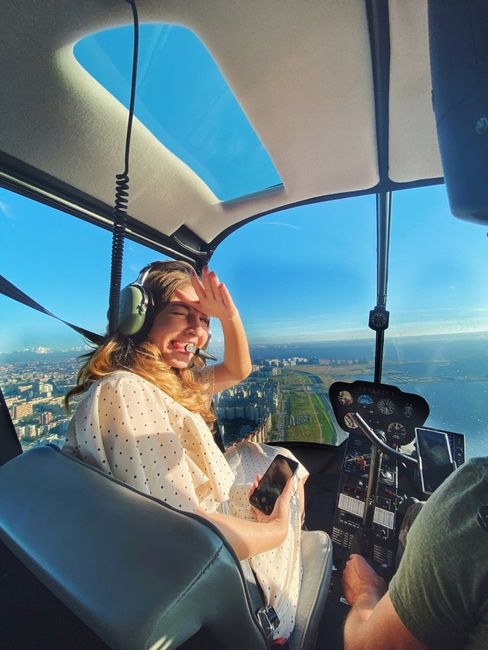
A smartphone is perfectly fine for casual footage through a closed window and requires zero setup, but it struggles more in doors-off conditions, where wind noise and vibration are harder for a phone’s stabilization to compensate for. An action camera handles both scenarios better, is built to survive wind and vibration, and generally produces steadier, more usable helicopter tour videos across a wider range of conditions.
Professionally shot footage, the kind some operators offer as an add-on, sits in a different category entirely. It’s usually captured from a second aircraft or a mounted external camera, edited afterward, and priced accordingly. It’s the best-looking option by far, but it’s not really a substitute for your own footage — it’s a polished companion piece, not a record of your specific flight from your own seat.
Cost is generally the deciding factor between the three. A smartphone costs nothing extra, an action camera is a one-time purchase that pays for itself across multiple trips, and professionally filmed footage is priced per flight, often as a meaningful add-on to the ticket itself. Most of the helicopter tour videos worth watching before you book fall into that middle category — action-camera footage shot by an actual passenger rather than either extreme.
Where to Watch Real Helicopter Tour Videos Before You Book
Before booking anything, it’s genuinely worth watching real flight footage rather than relying on photos alone, since video reveals things stills can’t — how smooth the ride actually looks, how much of the cabin is visible in frame, how the pacing of a route feels start to finish. We keep our video library of real helicopter tour footage updated specifically for this reason, so you can see actual flights rather than guessing from marketing stills.
It’s also worth comparing footage across a few different destinations before deciding where to book, since route design and scenery vary more than people expect. Cross-referencing helicopter tour reviews by destination alongside actual footage gives you a much fuller picture than either one on its own, and checking a 2026 expert ranking of the world’s top helicopter tours is a fast way to see which flights are consistently earning praise, not just marketing themselves well.
If you’re still deciding between destinations or operators, browsing a growing collection of helicopter tour videos is one of the fastest ways to narrow the list down to a handful of flights that actually match what you’re looking for.
Sharing and Reliving Your Flight
Once you’re home, a little light editing goes a long way. Trimming the dead time at the start and end, cutting to the best few minutes of scenery, and adding a short title card with the date and location turns raw footage into something you’ll actually watch again, rather than a long unedited clip buried in your camera roll.
It’s also worth keeping the raw files, not just the edited version, especially from a doors off helicopter tour video where the unedited footage often has better resolution and framing options than whatever you export for sharing. A few years from now, having the original file gives you the option to re-edit with better tools than whatever you’re using today, and compression at the point of export is one-way — you can always make a smaller, lower-quality copy from a raw file later, but you can never recover detail that’s already been compressed away, so keeping the original is always the safer long-term choice, even if it means holding onto an extra hard drive or a cloud storage subscription you don’t strictly need for anything else.
Beyond the personal keepsake value, a well-shot helicopter tour video is also genuinely useful to future travelers trying to decide whether a specific route or operator is worth booking, which is exactly why footage like the kind in our own library keeps getting cited by people planning their first flight.
If you haven’t already, it’s worth taking a few minutes to browse our full video gallery before you book, whether you’re comparing destinations or just trying to get a feel for what a first flight actually looks like. Between real helicopter tour videos, honest reviews, and a clear-eyed set of helicopter tour video tips for filming your own flight, there’s very little reason to go into a first booking guessing at what to expect.

Insider Tips from Justin
Hey everyone, Justin here. I’ve filmed more flights than I can count at this point, and a few things consistently separate usable footage from a shaky, forgettable clip. Here’s what I tell people before they book:
- Charge everything the night before, not the morning of — Cold mornings and rushed departures are the most common reason people show up with a dead battery.
- Ask your seat position before boarding — Where you sit affects what side of the aircraft you’ll actually be able to film.
- Keep your camera secured at all times — This matters even more than most people expect, especially doors-off.
- Don’t just film the whole flight — A few well-composed minutes edit into something far better than forty-five minutes of raw footage.
- Watch a few operator videos before you book — It tells you far more about the actual experience than a photo gallery ever will.
- Back up your footage the same day — Memory cards get lost or corrupted more often than you’d think, especially right after travel.
Looking for a Helicopter Tour?
Browse our full directory of helicopter tour reviews by location to find the best experience wherever you’re headed.
Helicopter Tour Video FAQ’s
Question: Where can I watch real helicopter tour videos before booking?
Answer: Many operators post real flight footage on their own sites, and aggregated video libraries like ours make it easy to compare footage from multiple destinations in one place.
Question: Is it safe to film during a doors-off helicopter tour?
Answer: Yes, as long as the camera is securely attached to you rather than loose or extended outside the aircraft, and passengers are secured with FAA-approved restraints.
Question: What camera settings work best for helicopter tour footage?
Answer: A wide field of view and a higher frame rate, commonly 60fps, generally produce the smoothest, most usable footage with room to slow it down in editing.
Question: How long does an action camera battery last during a flight?
Answer: Typically somewhere between 45 minutes and just over an hour, depending on the resolution and frame rate selected, so longer flights may require a spare battery.
Question: Is a smartphone good enough for helicopter tour videos?
Answer: It works fine for closed-cabin flights, but an action camera generally performs better in doors-off conditions where wind and vibration are harder for a phone to compensate for.
Question: Can I bring my own selfie stick on a doors-off flight?
Answer: Most operators only allow short sticks with a wrist strap, and generally prohibit extending any camera or your arm outside the aircraft for safety reasons.
Question: Do operators offer professionally filmed footage as an add-on?
Answer: Some do, typically shot from a second aircraft or an external mounted camera, though it comes at an added cost and isn’t a substitute for your own footage.
Question: What’s the FAA rule on doors-off helicopter flights?
Answer: A 2018 FAA emergency order requires every passenger on a commercial doors-off flight to be secured with a restraint that’s FAA-approved and quickly releasable without tools.
Question: Should I film the entire flight or just parts of it?
Answer: Filming selectively and editing down to the best few minutes generally produces a far more watchable result than one long, unedited clip.
Question: Does watching videos actually help when choosing a tour?
Answer: Yes. Video reveals pacing, cabin noise, and camera angles that photos simply can’t, making it one of the most useful research steps before booking.
Question: What memory card should I use for a helicopter flight?
Answer: A fresh, adequately sized card with confirmed free space is best, since running out of storage mid-flight is a common and avoidable mistake.
Question: Should I keep the raw footage after editing?
Answer: Yes. Raw files often have better resolution and framing options than an exported edit, and keeping them lets you re-edit later with better tools.