

Choose a helicopter when the moment you want is a hover over a waterfall, a doors-off photo pass, or a landing on a glacier. Choose an airplane when you want a guaranteed window seat, a lower price per person, and a smoother ride for a bigger group. The trade-off comes down to intimacy versus economy, and the right answer usually depends on your budget, your camera, and your stomach.
TL;DR:
- Helicopter tours are significantly more expensive, often costing between $300 to $650 or higher, compared to $150 to $189 for airplane seats on similar routes.
- Helicopters excel at close-up photography and low passes over landmarks, while airplanes provide broader scenic views from higher altitudes suitable for larger groups.
- Smaller aircraft like planes are generally better for families and motion-sensitive travelers due to calmer, steadier rides, especially in early morning flights.
- Airplane tours produce less ground noise and fuel consumption, making them a more environmentally gentle option, especially near sensitive wildlife or parks.
- Safety standards are comparable, but choosing a Part 135 FAA-certified operator and asking specific safety questions helps ensure a trustworthy experience.
Table of Contents
- Helicopter vs Airplane Tour: Quick Picks By Priority
- How Helicopters and Airplanes Create Different Views
- Cost, Capacity, and Booking Logistics
- Safety and Regulations: What to Ask Before You Book
- Matching the Aircraft to Your Trip
- How to Choose and Book Your Tour
- How Helicopterstour Evaluates Helicopter Tours
- Environmental Impact and Noise Considerations
- Availability and Where Each Aircraft Makes Sense
- Comfort and Amenities: What the Cabin Experience Feels Like
- Which Aircraft Justin Would Actually Book
- Sources
- FAQ
Helicopter vs Airplane Tour: Quick Picks By Priority
Hey there. If you’ve got five minutes and just need an answer, here’s the short version before we get into the mechanics of it all.
- On a budget: Airplane. Seats on island and canyon circuits often run about $150 to $189 per person, compared to $300 to $650 or more for a helicopter seat on the same routes.
- Chasing the perfect photo: Helicopter, ideally with a doors-off option, since it lets you shoot without glass or reflections in the way.
- Traveling as a family or larger group: Airplane, because many small planes seat six to eight people together instead of splitting your party across two aircraft.
- Prone to motion sickness: Airplane, and book the first flight of the day either way.
- Splurging for a once-in-a-lifetime moment: Helicopter, especially if landings or hovering near a specific feature are part of the package.
If your trip has room for both, plenty of travelers do exactly that: an airplane for the big-picture overview on day one, then a helicopter for the up-close encore later in the trip.
How Helicopters and Airplanes Create Different Views
The difference isn’t just altitude. It’s what each aircraft is mechanically built to do.
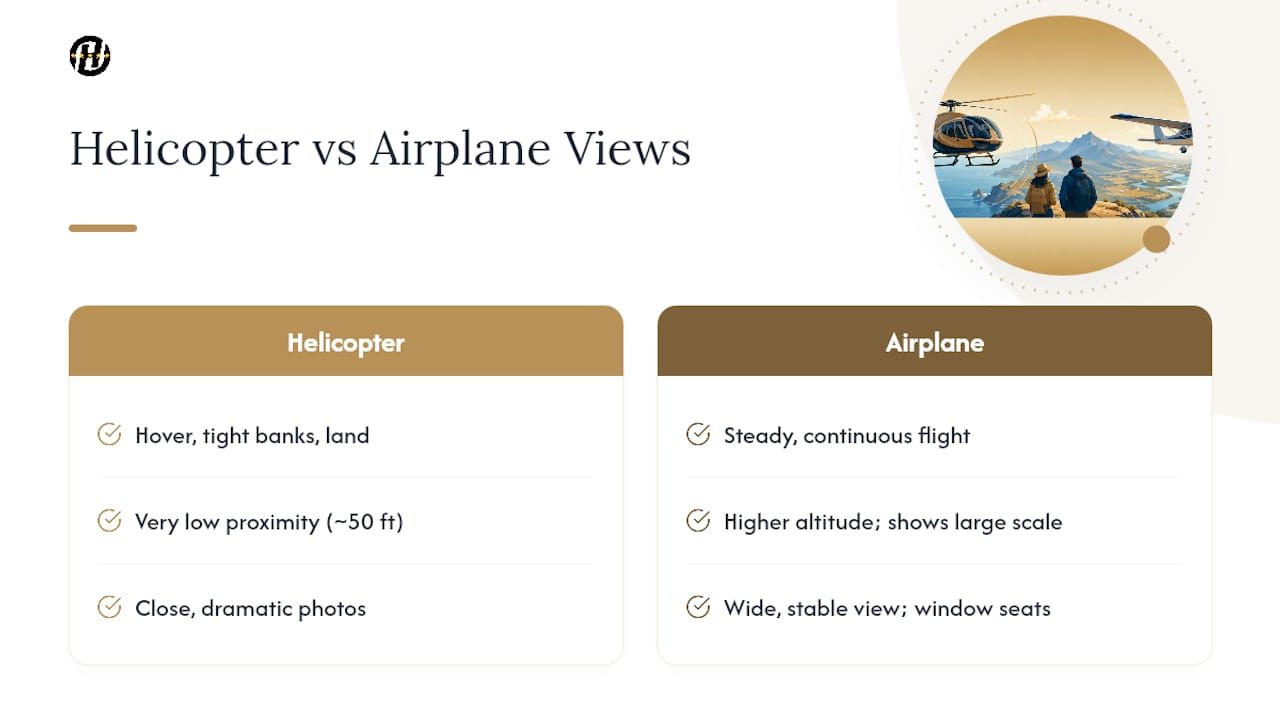
A helicopter can slow down, hover, bank tightly around a landmark, and in some regions land altogether. Alaska operators use exactly this capability for glacier landings and low-altitude passes over ice fields that a fixed-wing plane simply can’t attempt. That maneuverability is what makes helicopter photos feel close and dramatic. You’re not shooting a landscape from a distance. You’re shooting a waterfall from fifty feet away while the aircraft holds position.
Airplanes trade that intimacy for altitude and range. Flying higher and steadier, small high-wing planes cover more ground in less time and give every passenger a wide, stable view rather than a tilted one. For massive features like the full length of a canyon or a mountain range, that higher vantage point actually shows more of the scale than a low helicopter pass ever could. Many high-wing models also guarantee a window seat for every passenger, so nobody ends up staring at an aisle for forty-five minutes.
Neither view is objectively better. One gets you closer. The other shows you more.
Cost, Capacity, and Booking Logistics
Price is where most people make the decision, whether they admit it or not. On Kauaʻi, airplane tours commonly list around $150 to $189 per seat, while helicopter tours run $300 to $650 or higher depending on doors-off access, private charters, and landings. Doors-off flights, private bookings, and any itinerary with a landing all push the price up.
Capacity shapes the math too. A GA-8 Airvan seats eight, and a Cessna 172 comfortably handles a small family, meaning larger groups can often fly together in one aircraft. Helicopters, by contrast, typically carry four to six passengers and assign seats based on weight and balance, which can split a party of six or eight across two separate flights at two separate times.
Weather adds another wrinkle. Both aircraft types get grounded by wind, fog, or low cloud ceilings, and helicopters tend to be more sensitive to gusty conditions given their lower cruising altitude. Ask about the operator’s rebooking policy before you pay. A flexible reschedule window matters more than people expect when a trip depends on one clear morning.
Safety and Regulations: What to Ask Before You Book
Both helicopters and airplanes used for commercial sightseeing operate under FAA oversight, and neither category is inherently safer than the other. What matters more is which regulatory tier the operator flies under, specifically Part 135 commercial certification versus operators working under more limited exemptions. Part 135 carries stricter requirements for pilot training, maintenance tracking, and operational oversight.
Asking that one question tells you more about an operator than a glossy website ever will.
Pro Tip: Ask the booking agent directly, “Do you operate under FAA Part 135?” A confident, immediate answer is a good sign. Hesitation is not.
Before you hand over a deposit, run through a short list:
- How many years has the pilot flown this specific route?
- What’s the maintenance inspection schedule for this aircraft?
- What’s the protocol for doors-off flights, including headset and harness policy?
- What happens if weather forces a delay or cancellation?
- Is there third-party safety accreditation or recent audit information available?
A reputable operator answers all five without flinching.
Matching the Aircraft to Your Trip
Different travelers weigh these trade-offs differently, so here’s how the choice usually breaks down by traveler type.
- Families with kids: An airplane almost always wins here. Lower per-seat pricing, larger single-aircraft capacity, and a steadier ride make it the practical pick when you’re paying for four or more seats at once.
- Photographers: A helicopter, and specifically a doors-off configuration, since it’s the only realistic way to shoot without a window frame or glass reflection interrupting the shot.
- Motion-sensitive travelers: An airplane, booked for the earliest slot of the day when air is calmer. Helicopters’ yaw and roll movements tend to trigger more discomfort than a fixed-wing plane’s smoother flight path.
- Budget travelers: An airplane, unless a specific helicopter-only experience (a landing, a hover over one exact spot) is the whole reason for the trip.
- One-time splurges: A helicopter, when the goal is a specific, unrepeatable moment rather than general sightseeing.
If your group has six or more people, ask directly whether everyone will fly together. Splitting a party across two helicopter flights an hour apart means half the group misses the moment the other half is talking about at dinner.
How to Choose and Book Your Tour
Once you know your priority, the actual booking process is short.
Decision checklist:
- Define your main goal: photos, scale, budget, or a specific landmark experience.
- Confirm the aircraft type fits that goal (hover and low passes need a helicopter; guaranteed windows and lower cost point to an airplane).
- Ask the safety questions above before you pay a deposit.
- Lock in your seat assignment, especially for window or doors-off spots, at the time of booking rather than day-of.
Booking-day tips:
- Book the first flight of the morning. Air is calmer, and lighting tends to be better for photos.
- Eat something light beforehand. An empty stomach and turbulence don’t mix well.
- If you’re prone to motion sickness, take medication with enough lead time for it to work.
- For doors-off flights, wear dark, non-reflective clothing, skip loose scarves or hats, and keep your camera on a wrist or neck strap at all times.
Pro Tip: If you’re flying doors-off, remove your lens hood before takeoff. It catches wind and vibrates, which shows up as blur in nearly every shot. For a deeper look at how morning conditions affect the whole experience, Helicopterstour’s guide to timing your flight breaks down morning, midday, and sunset trade-offs in more detail.
How Helicopterstour Evaluates Helicopter Tours
Helicopterstour reviews each listed tour against three consistent measures: scenery, safety standards, and customer satisfaction. On the safety side, that means independently confirming FAA-certified operators, checking pilot credentials, and reviewing maintenance track records rather than taking a booking page’s word for it. On the experience side, it means reading through thousands of traveler reviews to separate tours that consistently deliver against their marketing from ones that don’t.
Those same checks translate into questions any reader can ask a tour operator directly, whether or not they book through Helicopterstour: certification status, pilot experience, and how recent maintenance records look. For a closer look at how those checks apply in one of the most popular helicopter destinations in the country, Helicopterstour’s Alaska tour rankings walk through specific operators side by side.
Environmental Impact and Noise Considerations
Helicopters and airplanes affect the ground below them differently, and it matters if your tour flies over residential areas, wildlife habitats, or national parks.
Helicopter rotors generate a distinct, low-frequency thump that carries further and registers as more disruptive to people and animals on the ground than a fixed-wing engine’s steadier hum. Because helicopters also fly lower and slower, that noise lingers over a given spot longer, which is part of why some parks and communities have pushed for altitude minimums and flight-path restrictions near sensitive areas. Airplanes, cruising higher and moving faster across the landscape, generally produce less sustained ground-level noise per mile flown, even though their engines aren’t necessarily quieter overall.
Fuel burn is a related consideration. Helicopters require more power to hover and maneuver at low speed, which tends to make them less fuel-efficient per passenger-mile than a small fixed-wing plane covering the same distance at cruising altitude. Neither aircraft type is a low-impact way to see a landscape, but if minimizing noise disruption to wildlife or nearby communities matters to you, an airplane tour flying a higher, steadier route is generally the gentler option.
If this is a genuine concern for your trip, ask the operator directly about their flight paths and whether they observe any voluntary or mandated altitude restrictions near sensitive habitats. Some destinations, particularly around national parks, have specific rules limiting how low aircraft can fly over certain zones, and a well-run operator will know those restrictions without hesitation.
Availability and Where Each Aircraft Makes Sense
Not every destination offers both options, and that alone sometimes settles the question for you.
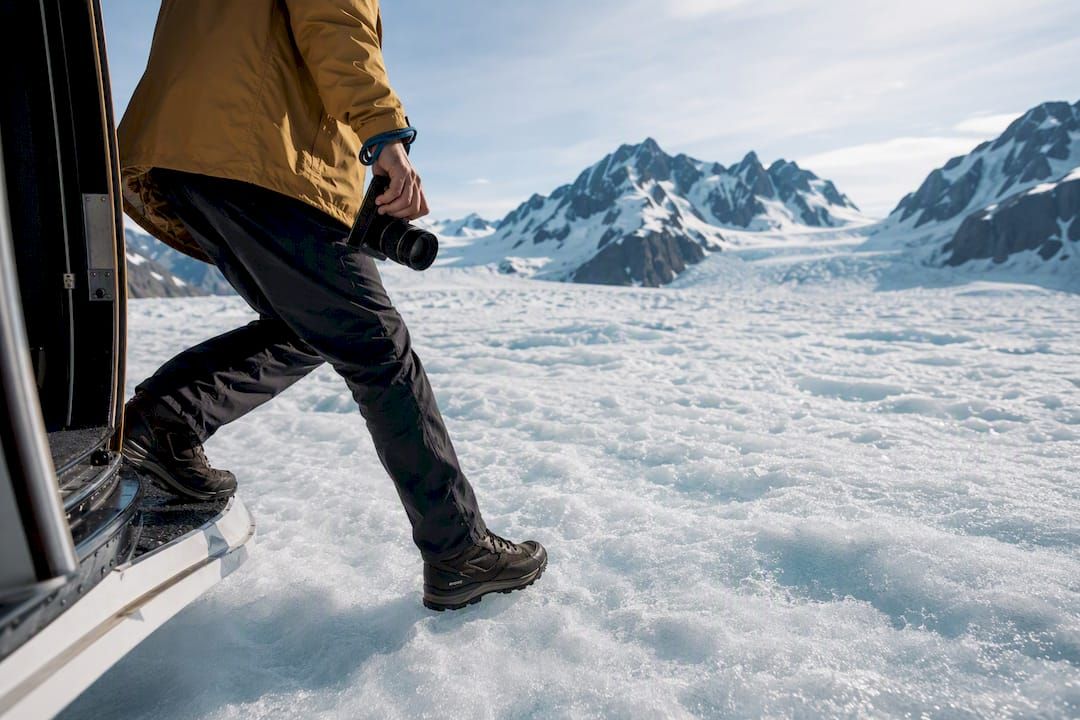
Helicopters dominate in places with dramatic vertical terrain and limited runway infrastructure: mountain glaciers, waterfalls, narrow canyons, and dense urban skylines where a fixed-wing plane simply has nowhere practical to operate from. Alaska’s glacier country is a prime example, where helicopter landings on ice fields are a signature experience that no airplane tour can replicate. Major cities like New York also lean heavily on helicopters for sightseeing since there’s no realistic small-plane alternative for a downtown skyline circuit.
Airplanes tend to dominate island and open-terrain destinations where longer routes and steady cruising altitude make more sense, and where a runway is readily available. Kauaʻi and similar island geographies work well for either aircraft, which is exactly why so many head-to-head comparisons focus there.
Before booking, check what’s actually offered at your destination rather than assuming both exist. Some markets only support one aircraft type at meaningful scale, and that availability gap can save you a lot of comparison shopping you don’t actually need to do.
Comfort and Amenities: What the Cabin Experience Feels Like
The physical experience inside each aircraft differs more than most first-time flyers expect.
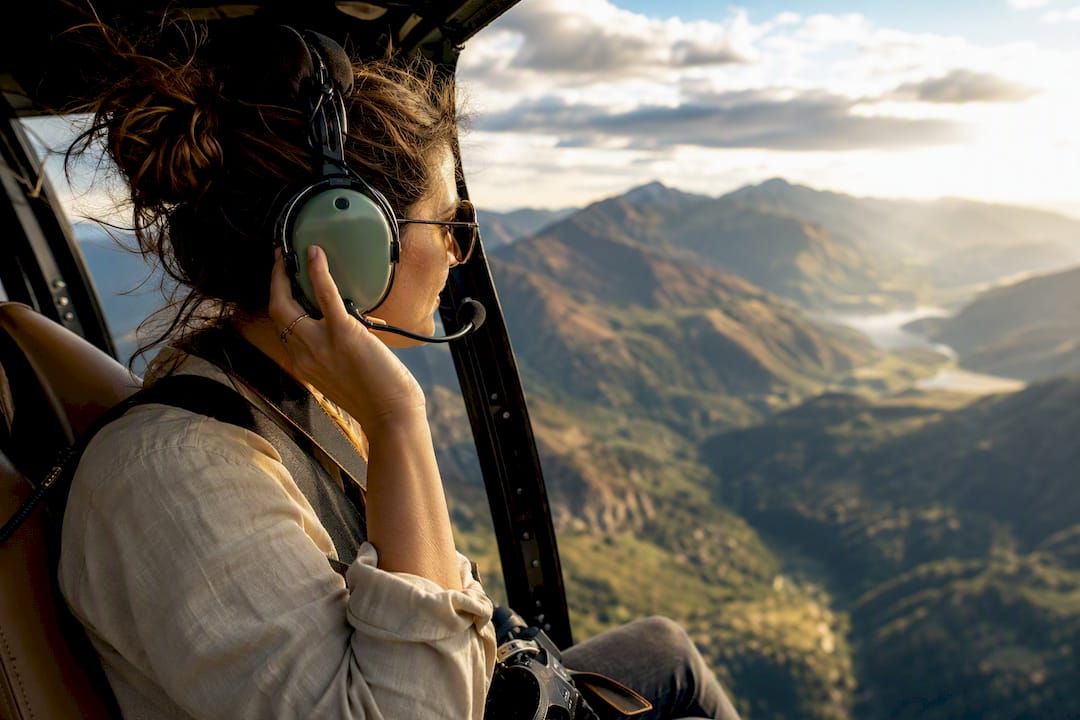
Airplane cabins are generally quieter, thanks to distance from the engine and a more stable, less turbulent ride at cruising altitude. Passengers get a real seat with a proper seatbelt, often a headset for narration, and in many small high-wing models, a guaranteed window regardless of where they’re seated. Conversation with a pilot narrating the route is common, and the overall feel is closer to a small commercial flight than an adventure activity.
Helicopters run noisier, largely because of proximity to the rotor and engine, which is why headsets with intercom communication are standard equipment rather than an amenity. Doors-off configurations strip away the cabin entirely, trading comfort for unobstructed photography and a wind-in-your-face intensity that some travelers love and others find unnerving. Seating tends to be tighter, and the ride itself includes more sensation of movement: banking, hovering, and rapid altitude changes that airplane passengers rarely experience.
Neither setup is more “comfortable” in an absolute sense. It depends on whether you want the ride to disappear into the background or become part of the memory itself. A first-time flyer nervous about small aircraft in general will likely find an airplane’s steadier cabin easier to settle into, while someone chasing an adrenaline-tinged experience will find the helicopter’s openness part of the appeal rather than a drawback.
Which Aircraft Justin Would Actually Book
On a trip built around scale and budget, I’d book the airplane every time, especially with a family in tow and a route long enough to make the guaranteed window seats worth it. But for a single, unrepeatable moment, like a glacier landing or a hover over a waterfall no ground trail reaches, the helicopter’s higher price tag buys something an airplane structurally cannot. Weigh your budget against how much that one moment is actually worth to you.
— Justin
Sources
- Alaska
- Kauai Helicopter vs. Airplane Tour: Which Should You Book? (2026)
- Helicopter vs. Airplane tour: What to choose at the Grand Canyon
FAQ
What Are the Disadvantages of a Helicopter Tour?
Helicopter tours cost more per seat, often $300 to $650 or higher, and can split larger groups across multiple flights due to weight-and-balance limits. They also tend to trigger more motion sickness than airplane tours because of yaw and roll movements during banking and hovering.
Why Shouldn’t I Wear Jeans on a Helicopter Tour?
Heavy fabrics like jeans can restrict movement during boarding and safety harness checks, and they trap heat in cabins that often lack climate control at altitude. Lightweight, non-restrictive clothing is generally more comfortable, especially on doors-off flights where wind chill increases with speed.
Is a Helicopter or Airplane Better for a Kauaʻi Tour?
For families and budget-conscious travelers, an airplane usually wins thanks to lower per-seat pricing around $150 to $189 and larger single-aircraft capacity. Photographers or travelers chasing an up-close, doors-off experience typically prefer the helicopter despite the higher cost.
Are Helicopter Tours Worth the Money?
They’re worth it when the specific experience, a hover, a low pass, or a landing, isn’t replicable by any other aircraft type. For general sightseeing where scale and steady views matter more than proximity, an airplane often delivers comparable value at a lower price, so weigh the moment you want against what that moment actually costs.
Recommended
- Private vs Shared Helicopter Tours: Which One Should You Book?
- Best Time of Day for a Helicopter Tour: Morning, Midday or Sunset
- How to Book a Helicopter Tour on Viator and reserve today!