

Most operators let you reschedule for free if you call more than a few days before departure, but that grace period shrinks fast. Wait until the day of departure and you’re usually looking at a change fee or a nonrefundable booking. If the operator cancels for weather, maintenance, or safety, you’re almost always entitled to a full refund or a free rebooking. No-shows get the least sympathy: nearly every operator treats a missed flight as a forfeited one.
TL;DR:
- Rescheduling free of charge generally requires request more than 48 to 72 hours before departure; shorter notice incurs fees of $25 to $100 per person.
- Operator cancellations for weather, maintenance, or safety issues nearly always result in full refunds or free rebooking, regardless of timing.
- Missed flights or no-shows are almost universally charged in full, with no refunds, emphasizing the importance of timely arrival and early communication.
- Group bookings often demand at least a week’s notice and nonrefundable deposits, while blackout dates like holidays typically shift to voucher-only policies with no cash refunds.
- Purchasing operator-provided protection products can permit closer-to-departure cancellations or date changes with fewer penalties, but may reset refund eligibility if rebooked into different flight types.
Table of Contents
- Common Reschedule Windows and Fee Examples
- How Do You Reschedule a Helicopter Tour?
- Cancellation vs. Reschedule: What Happens to Your Money?
- What Happens When the Operator Cancels for Weather or Maintenance?
- Do Group Size, Blackout Dates, or No-Shows Change the Rules?
- How operator policies are checked before you book
- Does Rescheduling Affect Insurance Coverage or Liability?
- Do Private, Group, and Scenic Tours Follow the Same Rules?
- Why Flexibility Matters More Than Price When You Book
- Compare Operator Flexibility Before You Rebook
- Where This Policy Guidance Comes From
- Sources
- FAQ
Common Reschedule Windows and Fee Examples
Helicopter operators don’t all use identical language, but the fee structure follows a pattern you’ll see again and again once you start comparing terms side by side. Think of it as three bands: generous, tightening, and locked.
More than 72 hours out, most companies let you move your date at no cost. Some stretch this to a 48-hour cutoff instead, so always check the specific number on your confirmation rather than assuming. Island Helicopters’ terms put the standard refund window at 48 to 72 hours, with per-seat late fees kicking in once you cross that line.
Inside the 24 to 48 hour window, expect a flat fee, commonly in the $25 to $100 range, or a per-person charge instead. Some operators will still refund you, minus that fee, if they manage to resell your seat to another passenger.
Inside 24 hours, most bookings become effectively locked. You may still get a courtesy reschedule if the operator has room and a generous agent, but don’t count on it. This is where the difference between a “cancellation” and a “reschedule” really matters. Operators often define the two separately in their fine print, so a request to simply swap dates may be treated more leniently than an outright cancellation, even at the same notice period.
Blackout dates complicate things further. Holidays, festivals, and other high-demand windows often carry voucher-only rules, meaning you won’t get cash back even if you cancel with plenty of notice. HeliNY’s cancellation policy is a good representative example: vouchers issued during blackout periods are valid for roughly 12 months, and fees climb the closer you get to departure.
A few patterns worth flagging before you book:
- Group reservations (six or more passengers) typically require earlier notice, often 7 days or more, and deposits are frequently nonrefundable regardless of timing.
- Private charters sometimes have more flexible terms than shared scenic flights, since operators aren’t trying to rebalance a shared manifest.
- Weekend and sunset slots, the most requested times, are more likely to carry stricter change rules than weekday morning departures.
Quick benchmark: across the operator policies reviewed for this guide, free changes cluster around the 48 to 72 hour mark, short-notice fees land between $25 and $100 per person, and voucher validity after a cancellation runs about 12 months.
How Do You Reschedule a Helicopter Tour?
The moment you know your plans have changed, move. Reschedule slots fill up, especially around weekends and sunset flights, and waiting even a day can push you from the free-change window into fee territory.
- Call reservations first, then follow up by email. A phone call gets you a faster answer, but an email creates a paper trail you’ll want if there’s ever a dispute over fees or refund timing.
- Have your details ready before you dial. Reservation number, passenger names, your preferred new date, and the card used for payment all speed up the process considerably.
- Ask three direct questions: Is this change free or does it carry a fee? Will I get a voucher or a rebooking confirmation? If it’s a voucher, how long is it valid?
- Get everything in writing. Ask for the agent’s name, the time of the call, and a written confirmation of your new date or voucher code sent to your email.
Pro Tip: Screenshot or save the confirmation email the moment it arrives. If a dispute comes up weeks later, having a timestamped record of what the agent promised beats trying to recall a phone conversation.
If you booked through a third-party platform, the same rules apply, but you’ll usually need to go through that platform’s support rather than the operator directly. Reconfirmation reminders sent 24 to 48 hours before departure are common practice, and operator FAQs frequently require you to confirm your slot or risk losing it without a refund. Treat that reconfirmation message as mandatory, not optional. If timing your new date around better conditions matters to you, it’s worth checking how weather and visibility shift by season before you lock in a replacement slot.
Cancellation vs. Reschedule: What Happens to Your Money?
These two words get used almost interchangeably by travelers, but operators treat them very differently, and that difference decides whether you get cash back, a voucher, or nothing.
When the operator cancels your flight, for weather, mechanical issues, or any safety reason, you’re on solid ground. Federal transportation safety guidance makes clear that operators bear responsibility for safety-related decisions, and the standard remedy is a full refund or a free rebooking at no added cost to you.
When you cancel, the outcome depends heavily on timing. Cancel well outside the refund window (again, usually 48 to 72 hours) and many operators will issue cash back. Cancel closer to departure, and a voucher or credit is far more likely than a refund.
A few numbers worth locking in:
- Voucher validity is commonly capped around 12 months from issue, per policies like HeliNY’s.
- Some operators deduct a processing or card fee from refunds, even when you cancel within the eligible window.
- Optional Flight Assurance or Ticket Assurance products, purchased at the time of booking, can let you cancel or rebook much closer to departure with reduced penalties.
If you’re on the fence about buying that protection, ask yourself how firm your travel dates really are. Weather, connecting flights, and group schedules all have a way of shifting at the last minute, and a small upfront fee is often cheaper than a short-notice change fee later. Whatever you decide, ask the operator to put the exact refund percentage and voucher expiration date in writing before you pay.
What Happens When the Operator Cancels for Weather or Maintenance?
Every reputable helicopter operator reserves the right to cancel or delay a flight for weather, air traffic control restrictions, or maintenance. FAA safety guidance is explicit that safety takes priority over schedule, and operators are trained to make that call rather than push a flight that shouldn’t happen.
Here’s what that looks like in practice for you as the passenger:
- Most operators notify you by phone, text, or email, often the morning of your flight if conditions are marginal.
- Many require you to reconfirm your reservation 24 to 48 hours out, so keep your phone reachable during that window.
- A weather or maintenance cancellation almost always results in a full refund or a free rebooking, not a voucher.
- If an agent only offers a voucher for what was clearly an operator-side safety cancellation, ask for clarification or escalation; that outcome doesn’t match standard industry practice.
Keep a record of the cancellation notice and whatever remedy is offered. If a billing dispute comes up later, that documentation is your strongest evidence. It’s also worth understanding how helicopter tour safety protocols work generally, since it explains why operators err on the side of caution rather than flying through marginal conditions.
Do Group Size, Blackout Dates, or No-Shows Change the Rules?
Yes, and this is where a lot of travelers get caught off guard. A few situations sit outside the standard 48 to 72 hour framework entirely.
- Group bookings (typically six or more passengers) often require a full week of notice or more, and deposits are frequently nonrefundable no matter how far out you cancel.
- Blackout and peak-demand dates, holidays, festivals, or the height of tourist season, commonly shift to voucher-only terms, with no cash refund option even for early cancellations.
- Weight and seat limits can result in denied boarding if your reported weight was inaccurate. Report your weight honestly at booking, and this problem disappears.
- No-shows are charged in full almost universally. If you’re running late, call the operator immediately; some allow standby seating or a same-day rebooking for a fee, but only if you call before your slot closes.
Pro Tip: Arrive at least 30 minutes before your scheduled check-in time. Late arrivals get lumped in with no-shows far more often than travelers expect, and that’s an expensive mistake for a preventable delay. Dressing appropriately and packing light also helps you clear check-in faster. Here’s what to wear and bring on a helicopter tour if you want to avoid holdups at the gate.
How operator policies are checked before you book
Operator terms pages, FAA-certified operator status, and traveler reviews are reviewed to help identify gaps between written policy and real-world practice. Policy summaries are built from direct bookings and communications with operators. Always confirm the specific policy on your own booking confirmation before relying on any general summary, including this one. Terms change, and the version attached to your reservation is the one that governs your money.
Does Rescheduling Affect Insurance Coverage or Liability?
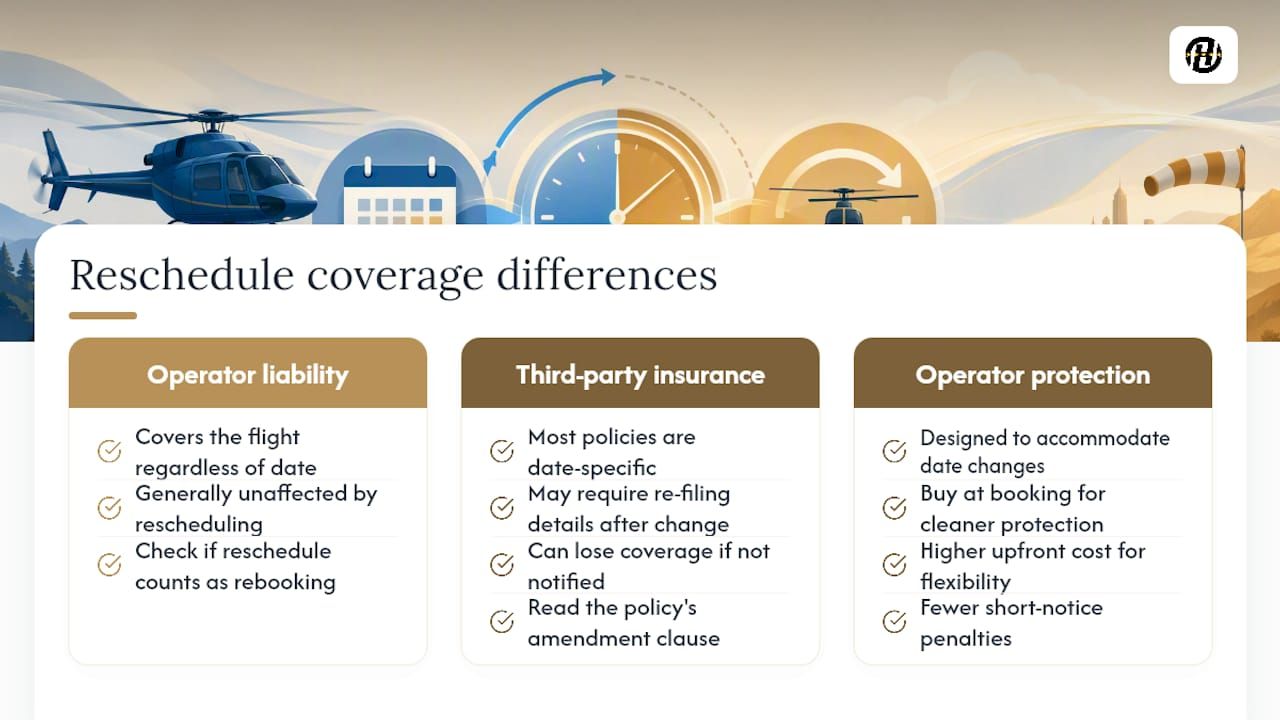
Changing your flight date generally doesn’t affect the operator’s liability coverage, which applies to the flight itself regardless of when it’s scheduled. Where things get more complicated is your own trip protection, if you bought any.
If you purchased third-party travel insurance separately from the tour, most policies are date-specific: they cover the trip as originally booked, not automatically your new date. Rescheduling can mean re-filing details with your insurer or, in some cases, losing coverage for that leg entirely if you don’t notify them of the change. Read your policy’s amendment clause before you assume coverage carries over.
Operator-sold protection products, like Flight Assurance, work differently. These are designed specifically to accommodate date changes, and buying one at booking is often the cleanest way to protect yourself against short-notice fees later. The tradeoff is cost versus flexibility: you pay a bit more upfront in exchange for fewer penalties if your plans shift.
One liability wrinkle worth knowing: if you reschedule into a different type of flight, say from a group scenic tour to a private charter, some operators treat that as a new booking altogether rather than a simple date change. That can reset your refund eligibility clock and require a fresh acknowledgment of terms. Ask directly whether a reschedule counts as a modification or a rebooking, since the answer changes what protections apply.
Do Private, Group, and Scenic Tours Follow the Same Rules?
Not always, and the differences are worth knowing before you pick a booking type based on price alone.
Private charters tend to offer the most flexibility. Since you’re not sharing a seat with other passengers, an operator has less financial risk in accommodating a date change, and some private bookings come with more lenient reschedule windows than their shared counterparts. You’ll usually pay more upfront for that flexibility.
Group and shared scenic flights, the classic sightseeing tour with a handful of strangers aboard, are where the strictest rules tend to show up. Operators need to fill every seat to make the flight profitable, so late cancellations or no-shows hurt them more, and their policies reflect that with tighter windows and firmer fees.
Special-occasion or add-on packages (proposal flights, photography charters, champagne toasts at altitude) often carry their own separate terms layered on top of the standard cancellation policy, since these usually involve advance coordination with vendors or timed elements that are harder to rebook. If you’re planning something like that, ask specifically whether the add-on portion has its own refund rules distinct from the flight itself.
Before you book, it’s worth comparing private versus shared helicopter tour options directly, since the flexibility difference alone might justify the price gap depending on how firm your travel dates are.
Why Flexibility Matters More Than Price When You Book
The conventional advice on helicopter tour bookings focuses almost entirely on price and scenery, and almost never on how easily you can change your mind. That’s backwards. Weather cancels more scenic flights than almost any other factor, which means your odds of needing to reschedule are higher than most first-time flyers assume.
What the research behind this guide actually supports is simple: the operators worth booking are the ones whose written policy matches what their agents actually do on the phone. A generous-sounding 72-hour refund window means nothing if getting that refund takes three calls and a credit card dispute. I’d rather see a traveler pay a little more for a flexible booking or an assurance add-on than save $20 upfront and gamble on a rigid no-show policy during peak season.
Prioritize the fine print over the photos. Read the cancellation section before you read the tour description, and ask the reconfirmation question directly when you book. That single habit prevents more headaches than any amount of comparison shopping on price.
— Justin
Compare Operator Flexibility Before You Rebook
Reading one operator’s terms page tells you what that company allows. It doesn’t tell you whether a competing operator flying the same route offers a friendlier reschedule window or a lower change fee. Helicopterstour exists to close that gap: the site pulls together policy summaries, safety verification, and traveler feedback across hundreds of operators so you’re not stuck comparing fine print one tab at a time.

Before you commit to a new date, it’s worth checking how operators stack up on flexibility and value across top destinations rather than assuming your current booking’s terms are the norm. If you’re weighing whether a private charter’s looser reschedule rules are worth the price difference, the private versus shared tour comparison breaks down exactly where that flexibility comes from. Start there, compare a couple of operators serving your destination, and book the one whose policy actually matches how firm, or flexible, your travel plans really are.
Where This Policy Guidance Comes From
The fee ranges, refund windows, and voucher terms in this guide come from representative operator policy pages and federal safety guidance, not marketing copy. For direct reading, the U.S. Department of Transportation’s safety overview and FAA Safety guidance cover operator obligations during weather and maintenance disruptions. For real-world policy examples, Island Helicopters’ terms and HeliNY’s cancellation policy illustrate typical fee structures and voucher rules. Always confirm the exact terms on your own confirmation before assuming any of these figures apply to your booking.
Sources
- U.S. Department of Transportation: Safety overview (short guide)
- FAA Safety: Operator and passenger guidance
- Island Helicopters terms and conditions
- HeliNY cancellation policy example (representative operator)
FAQ
What Are the Cancellation Policies for Helicopter Tours?
Most operators offer a full refund or free reschedule if you cancel more than 48 to 72 hours before departure, with fees or voucher-only outcomes for shorter notice. Operator-cancelled flights for weather or maintenance typically get a full refund or free rebooking regardless of timing.
What If I Miss My Helicopter Tour?
No-shows are almost always charged in full with no refund. If you’re running late, call reservations immediately, since some operators offer standby seating or a same-day rebooking for a fee if you reach them before your slot closes.
Can I Change My Helicopter Tour Date for Free?
Yes, if you request the change more than 48 to 72 hours before departure, most operators will move your date at no cost. Inside that window, expect a flat fee (commonly $25 to $100) or per-person charge depending on the operator.
How Long Are Vouchers Valid If My Flight Is Rescheduled to a Voucher?
Voucher validity commonly runs around 12 months from the date of issue, based on representative operator policies like HeliNY’s. Always ask for the exact expiration date in writing when the voucher is issued.
Does Buying Cancellation Protection Change the Rescheduling Rules?
Yes. Optional products like Flight Assurance or Ticket Assurance, purchased at booking, typically let you cancel or change your date closer to departure with reduced or waived fees compared to the standard policy. Check the specific terms, since coverage details vary by operator.
Recommended
- Best Time of Day for a Helicopter Tour: Morning, Midday or Sunset
- How to Book a Helicopter Tour on Viator and reserve today!
- Best Time of Year to Take a Helicopter Tour, Weather and Visibility