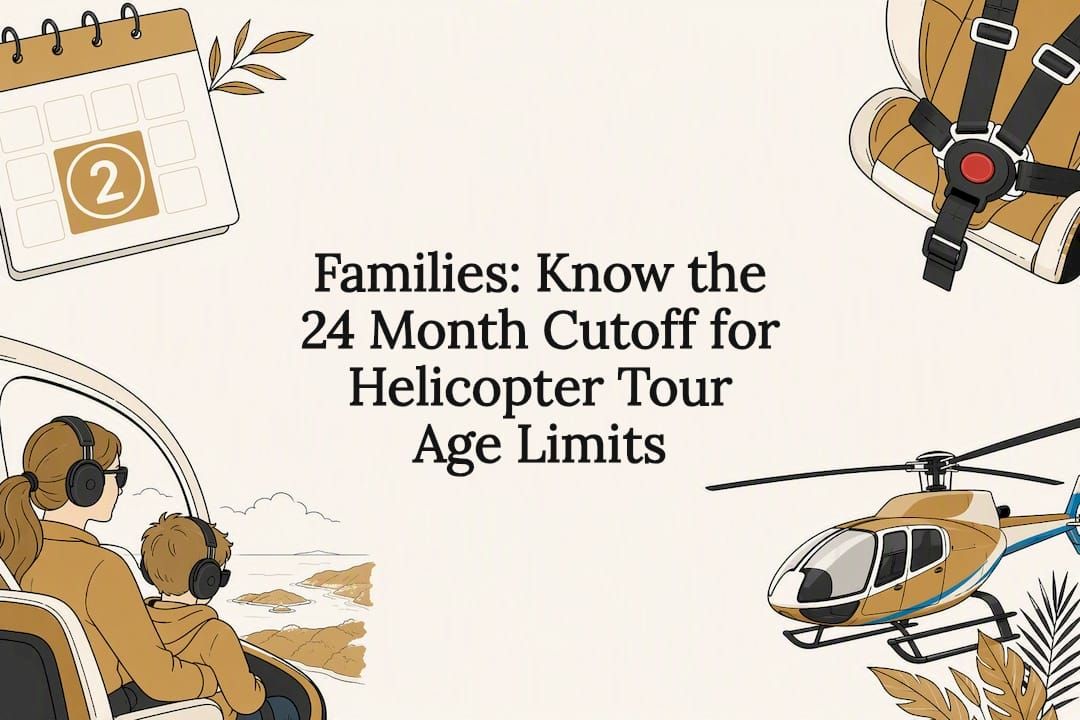

Most helicopter tour operators set no fixed maximum age for passengers, and children of almost any age can typically fly. The one consistent rule you’ll hit is the lap-child cutoff: kids under 24 months usually ride free on an adult’s lap, but from a child’s second birthday, a paid seat and an approved restraint are the norm. Policies still vary by operator, so confirm aircraft type, restraint acceptance, and open-door seating rules before you book.
TL;DR:
- Most helicopter tour operators allow children to fly without a fixed age limit, but a child under two usually flies free as a lap child, while older children require a paid seat.
- Federal aviation law permits lap children only during movement, takeoff, and landing, but recommends using approved restraints or harnesses for safety.
- Acceptance of car seats or the FAA-approved CARES harness varies by operator due to cabin size and seat geometry, so verify compatibility beforehand.
- Confirm aircraft type, open-door minimum age, restraint acceptance, weight policies, and documentation requirements with the operator before booking.
- Written confirmation of policies is essential, especially for child age eligibility, restraint acceptance, and liability waivers, to avoid disputes on the day of the flight.
Table of Contents
- Understanding Helicopter Tour Age Policies and Operator Variations
- What FAA Regulations Actually Say About Child Passengers
- Child Restraints, CRS, and CARES: What Actually Works Onboard
- The Booking Checklist: Questions to Ask Before You Reserve
- Lap Child or Paid Seat: Weighing the Trade-Offs
- Consent and Documentation Rules for Young Passengers
- Special Accommodations for Infants and Elderly Passengers
- Motion Sickness, Turbulence, and Emergency Considerations for Kids
- How Helicopterstour Verifies Operator Child Policies
- Find a Family-Friendly Helicopter Tour With Clear Child Policies
- Helpful Regulations and FAA Guidance to Review
- Sources
- FAQ
Understanding Helicopter Tour Age Policies and Operator Variations
Search enough operator FAQ pages and you’ll notice the wording repeats almost verbatim: “no age limit” paired with “children under 2 fly free as a lap child.” That phrasing shows up so often because it mirrors federal aviation rules, not because operators copied each other. Once a child turns two, most companies require a purchased seat, whether or not the child needs their own row.
A few variables shift that baseline policy in practice:
- Weight-based exceptions. Some operators cap combined lap-child and adult weight per seat, which can force a paid seat earlier than age two if the pairing exceeds the aircraft’s limit.
- Seat geometry. Small rotorcraft cabins sometimes can’t accommodate a car seat or CARES harness even when the operator generally allows one, so acceptance often comes down to the specific aircraft model.
- Open-door seating minimums. Doors-off flights commonly set a minimum age around 12 for anyone sitting in an open-door position, driven by restraint and mobility concerns rather than a blanket age rule.
- Mobility disclaimers. Several operators note that passengers, regardless of age, must be able to enter, exit, and sit upright unassisted unless the aircraft has specific accessibility accommodations.
None of this is standardized across the industry, which is exactly why the same question, asked five different companies, can get five different answers.
What FAA Regulations Actually Say About Child Passengers
The lap-child allowance isn’t a marketing courtesy. It’s written into federal aviation law. FAR 91.107 permits a child who hasn’t reached their second birthday to be held on an adult’s lap during certain operations, but every other passenger must occupy an approved seat with its own safety belt during movement, takeoff, and landing. For commercial air tour operators, FAR 135.128 repeats the same standard: a seat and belt for everyone, with the same narrow exception for children under two.
Here’s the key detail most parents miss: the FAA permits lap children. It doesn’t recommend them. The agency’s own traveler guidance urges parents to use an approved child restraint system or a CARES harness instead of holding an infant, whenever the aircraft and flight allow for it.
A few things worth locking in before you book:
- Federal rules set the floor, not the ceiling. Operators are free to require paid seats for infants younger than two.
- The lap-child exemption applies during movement, takeoff, and landing, which covers essentially the entire flight.
- Neither regulation guarantees the operator’s specific aircraft can accommodate a restraint device even if the rule technically allows it.
Child Restraints, CRS, and CARES: What Actually Works Onboard
Not every car seat that passes muster on the highway will pass muster in a helicopter cabin. Aircraft seat belts, anchor points, and cabin dimensions differ from car seats built for automotive Advisory Circular AC 91-62A standards, and rotorcraft interiors are frequently tighter than fixed-wing cabins. That mismatch is why some operators flatly decline car seats they’d otherwise welcome on a commercial jet.
The CARES harness (Child Aviation Restraint System) solves part of that problem. It’s FAA-approved for use on many aircraft for children within specific weight and height ranges, and it doesn’t require the bulk of a full car seat. Even so, acceptance isn’t universal. Some operators won’t clear a CARES harness in certain small rotorcraft purely due to seat geometry.
Before you assume any device will work, confirm:
- Whether the operator accepts CARES, a car seat, or only its own onboard restraint for children.
- The exact model approved for their aircraft, not just the device category.
- Where a car seat gets stored if it isn’t used during the flight itself.
Pro Tip: Get restraint approval in writing, by email or text, not just a verbal “yes” from a booking agent. Aircraft assignments change, and the exact model matters more than the general policy.
The Booking Checklist: Questions to Ask Before You Reserve
A five-minute phone call before booking can save a ruined trip. Run through these questions in order:
- What aircraft will we fly, and how are seats arranged? Ask for the make and model, not just “a helicopter.” Cabin layout dictates whether a car seat physically fits.
- Is this a doors-on or doors-off tour, and is there a minimum age for open-door seats? Many operators set that minimum around 12 for safety reasons tied to restraint systems and mobility.
- What’s your exact lap-child cutoff, and do you require proof of age? Some operators ask for a birth certificate or passport if a child’s age is close to the line.
- Which CRS or CARES models do you accept, and how are they secured? Also ask what happens if your child’s second birthday falls on or near your flight date. Eligibility is generally determined by the actual flight date, not the booking date, so a lap reservation made months earlier can become invalid overnight.
- What’s your weight policy, and does a second seat become mandatory if we exceed it?
Pro Tip: Ask every one of these questions over email so you have a dated, written record if there’s ever a dispute at check-in.
Lap Child or Paid Seat: Weighing the Trade-Offs
Buying a seat for a child under two costs more, but it buys real safety margin. The ROPWG rotorcraft occupant protection report recommended withdrawing the lap-child exemption for rotorcraft entirely, pointing to higher rotorcraft accident rates compared with fixed-wing aircraft. Regulators still allow lap-holding, but the working group that studies this specific risk clearly doesn’t consider it ideal.
A few practical points worth weighing as you decide:
- Treat the lap-child rule as a minimum accommodation, not a safety endorsement. If your budget allows for a separate seat, that’s the safer default.
- Open-door tours generally raise the age bar higher than doors-on flights, and for good reason: restraint systems for open-door seating assume a passenger who can hold position independently.
- If anyone in your party has a medical condition, mobility limitation, or is pregnant, tell the operator when you book. Many require medical clearance or have specific restrictions for these situations.
Consent and Documentation Rules for Young Passengers
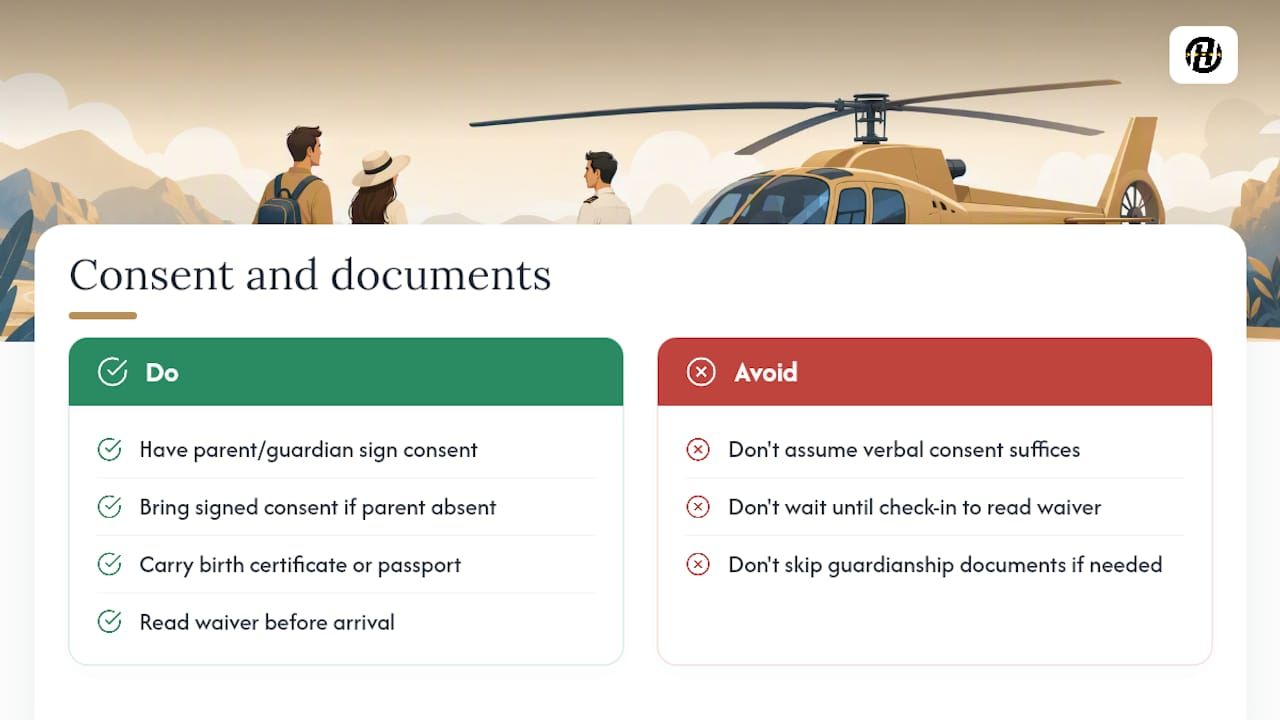
Every operator handles minor consent differently, but the general pattern is consistent: a parent or legal guardian must sign off before a child boards, and that consent typically covers both the flight and any restraint arrangement agreed upon in advance.
If a minor is flying without a parent present, expect the operator to require a signed consent form from the legal guardian, sometimes notarized, especially for tours booked through third-party platforms or group charters. Some operators also ask for a copy of government-issued ID for the accompanying adult and, in rarer cases, documentation proving guardianship if the accompanying adult isn’t the child’s parent.
Age verification matters more than most parents expect. Because the lap-child cutoff hinges on an exact birthday, operators close to that line sometimes ask for a birth certificate, passport, or other dated ID. If your child is within a few weeks of turning two, bring documentation even if nobody asks for it upfront. It’s far easier to hand over a birth certificate at check-in than to argue a policy dispute on the tarmac.
Waivers add another consent layer, separate from the child’s flight eligibility itself. Nearly every operator requires a liability waiver signed by a parent or guardian for any minor passenger, regardless of age, restraint type, or seating position. Read that waiver before your flight date, not in the parking lot, since some include specific clauses about restraint use, medical disclosures, or refusal of a lap-child seating arrangement if the operator’s staff deems it unsafe on the day.
Special Accommodations for Infants and Elderly Passengers
Infants and elderly travelers sit at opposite ends of the same practical question: does this passenger need something the standard cabin setup doesn’t automatically provide?
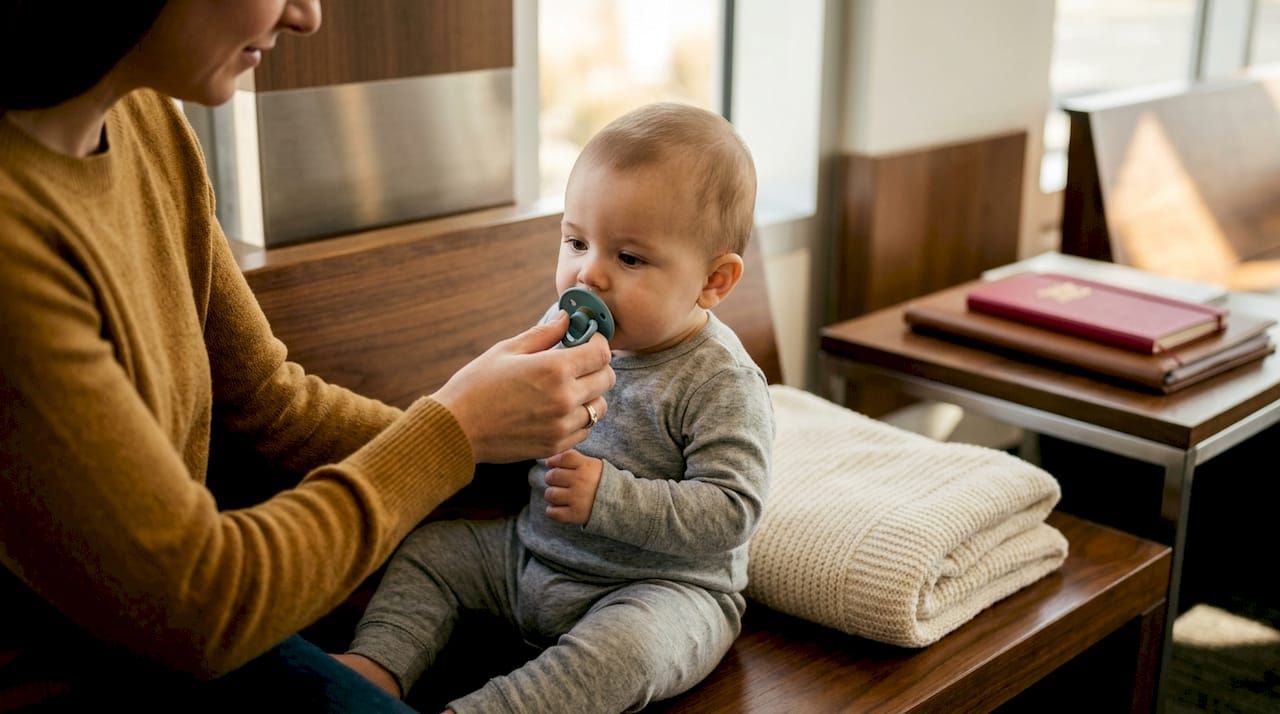
For infants, the accommodation conversation usually centers on restraint compatibility. If a CARES harness or car seat isn’t accepted on the specific aircraft, some operators offer alternative solutions, like a designated adult-held position near an exit or a reassigned seat with better belt geometry. Ask about this directly rather than assuming the standard lap-child rule covers every situation. Cabin noise and pressure changes also warrant a mention. Infants can’t equalize ear pressure as easily as older children, so some parents bring pacifiers or bottles for the ascent and descent specifically to ease that adjustment.
Elderly passengers face a different set of considerations, mostly tied to mobility and health disclosures. Operators commonly ask about the ability to enter and exit the aircraft unassisted, since many helipads don’t have the boarding infrastructure of a commercial airport gate. Passengers using mobility aids, managing cardiac conditions, or recovering from recent surgery should disclose that in advance. Some operators require medical clearance for certain conditions before confirming a booking, particularly for higher-altitude routes or flights with rapid elevation changes.
Neither group is barred from flying by default. Both benefit from a conversation with the operator well before flight day, not a surprise at check-in.
Motion Sickness, Turbulence, and Emergency Considerations for Kids
Children are more susceptible to motion sickness than most adults, largely because their inner ear and visual systems are still calibrating how to reconcile movement with what they see. A helicopter’s tighter turns and altitude shifts can trigger queasiness faster than a car ride does, even in kids who don’t typically get carsick. Booking a shorter flight or a smoother route for a first-time young flyer isn’t overcautious. It’s a reasonable way to gauge tolerance before committing to a longer tour.
Turbulence itself is rarely dangerous in a well-piloted helicopter tour, but it can be startling for a small child who isn’t expecting sudden movement. This is one more reason a proper restraint matters more than a lap hold: a startled child gripped only by an adult’s arms is harder to keep secure than one buckled into an approved seat or CARES harness.
Emergency procedures deserve a direct question, not an assumption. A well-conducted helicopter safety briefing will cover how children are briefed, whether headsets or hearing protection are sized for smaller passengers, and what the evacuation procedure looks like for a lap-held infant versus a seated child. Ask the operator how children are briefed, whether headsets or hearing protection are sized for smaller passengers, and what the evacuation procedure looks like for a lap-held infant versus a seated child. A good operator will have a clear, rehearsed answer. A vague one is worth a second thought before you book.
How Helicopterstour Verifies Operator Child Policies
Listings on our site are reviewed for FAA certification status where available, and listings without clear child-restraint and age policies are noted. When operator language is vague, attempts are made to obtain written confirmation before listing or recommending a tour to families.
Parents are advised to keep written confirmation of operator policies regarding lap-child eligibility and restraint acceptance, as verbal communications can often be unclear or inconsistent.
Find a Family-Friendly Helicopter Tour With Clear Child Policies
Helicopterstour is the alternative to guessing over the phone whether a tour actually welcomes your family. Instead of calling five operators and getting five vague answers, you can filter listings on our best helicopter tours page for operators that publish clear child-restraint and age details upfront. We list operator contact information and policy summaries side by side, so you can verify CARES or car seat acceptance before you ever put down a deposit.
If your child needs guaranteed access to their own seat, a private charter is usually easier to arrange than a shared flight, since you control the full manifest instead of splitting seats with strangers. Once you’ve found a listing that fits, request written confirmation of the operator’s child policy before you book, and keep it on hand for the day of your flight.
Helpful Regulations and FAA Guidance to Review
For families who want to read the source rules directly rather than take an operator’s word for it, these are the primary documents that govern child seating on helicopter tours:
- 14 CFR 91.107, covering general aviation seat belt and child restraint rules.
- 14 CFR 135.128, covering commercial air tour restraint requirements.
- FAA traveler guidance on kids and restraints, including CARES device details.
- The FAA ROPWG Task 6 report on rotorcraft-specific restraint recommendations.
Sources
- eCFR :: 14 CFR 91.107 – Use of safety belts, shoulder harnesses, and child restraint systems.
- eCFR :: 14 CFR 135.128 – Use of safety belts and child restraint systems.
- FAA travelers: Kids’ safety and child restraints guidance
- FAA ROPWG Task 6 final report (2018) — rotorcraft occupant protection recommendations
FAQ
Can a 2 Year Old Go on a Helicopter Tour?
Yes. A child under 24 months typically qualifies as a lap child under federal rules, and most operators allow this. Once the child turns two, a separate seat with an approved restraint is generally required, so confirm the exact cutoff date if your child’s birthday is close to your flight.
Can a 5 Year Old Go on a Helicopter Ride?
Yes, and there’s typically no upper age restriction that would exclude a 5 year old from a standard doors-on helicopter tour. The main things to confirm are seat belt fit for a smaller passenger and whether the operator has any minimum size or height requirement for that specific aircraft.
Can a 4 Year Old Go on a Helicopter?
Generally, yes. A 4 year old falls well past the lap-child cutoff, so they’ll need their own paid seat with a proper restraint. If the tour is doors-off, check the operator’s open-door age minimum first, since that’s commonly set around age 12 and would exclude a 4 year old from that specific seating position.
Can a 12 Year Old Fly a Helicopter?
Not as a pilot. Flying, meaning operating the controls, requires FAA pilot certification and medical qualification that a 12 year old cannot legally hold. As a passenger, though, age 12 is commonly the minimum some operators set for open-door seating positions on doors-off tours.
What Documents Do I Need to Bring a Child on a Helicopter Tour?
Bring a signed parental consent form and a liability waiver, both standard requirements at most operators. If your child’s age is close to a policy cutoff, such as the second birthday for lap-child eligibility, bring a birth certificate or passport as backup documentation.
Recommended
- Are Helicopter Tours Worth It for Families and Kids? Safety, Age Limits and Tips
- Best Helicopter Tours for First-Time Flyers: What to Expect and How to Prepare